
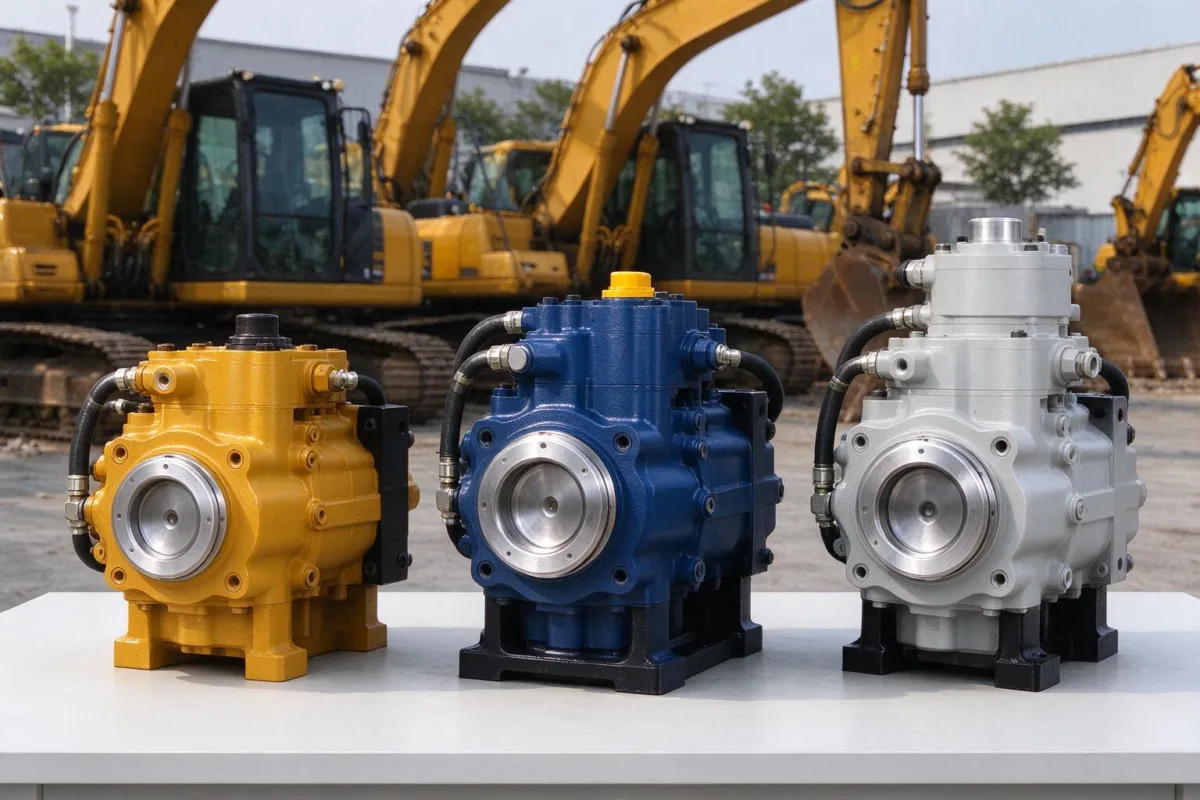
This XCMG excavator hydraulic pump supplier comparison covers the supplier categories available to B2B buyers, with attention to the technical and commercial factors that affect sourcing decisions. The aim is to give purchasing and maintenance teams a structured basis for evaluating their options, not to rank individual vendors. Coverage includes main pumps and control valves for XCMG excavator series such as XE215, XE265, XE335, XE370, and XE490. These models span the mid-size to large crawler excavator range, and their hydraulic systems differ in displacement, pressure rating, and control architecture. Buyers should confirm the specific pump variant and control valve configuration against the machine serial number before comparing quotes.
XCMG Excavator Hydraulic Pump Basics
Most XCMG excavators in the 20–50 ton class use variable displacement axial piston pumps, frequently in tandem configuration with integrated regulators. Each pump section supplies a separate circuit, and the regulators control displacement in response to load-sensing or negative flow control signals from the main control valve.
Common pump families include the Kawasaki K3V and K5V series and the Rexroth A8VO series, depending on model and production year. The table below lists typical configurations by model series.
| XCMG Model | Typical Pump Configuration |
|---|---|
| XE215 | K3V112DT |
| XE265 | K3V140DT |
| XE335 | K3V180DT |
| XE370 | K5V160DTP |
| XE490 | K5V200DTP |
Pump identification requires the machine serial number, pump nameplate data, and regulator type. XCMG may change suppliers mid-series, so the model designation alone is not sufficient to confirm fitment. Regulator and solenoid configurations also vary by emission standard and market region. Cross-referencing must therefore include the complete pump assembly number, not only the base pump model, to ensure the replacement matches the original hydraulic and electronic control setup.
Supplier Category 1: Authorized OEM Channel
Authorized XCMG dealers supply hydraulic pumps with full traceability to XCMG’s production part number and the latest revision level. Each pump carries documentation linking it to the applicable parts catalog entry for the machine series, whether that is the XE215C, XE335C, or XE490D. This traceability matters because XCMG revises pump assemblies and regulator settings over a model’s production life; a superseded part number may fit physically but carry different compensator or torque-limiting settings than the current release.
Advantages
- Guaranteed fit. The pump is matched to the machine’s serial number range and hydraulic circuit configuration, including the correct displacement and control type (negative flow control or positive flow control, depending on series).
- Updated regulator settings. Dealers supply the current revision, so pressure cut-off and flow compensation values reflect XCMG’s latest production specification rather than an earlier build.
- Warranty honored through XCMG’s network. Failures are processed within the OEM warranty system, which matters for machines still under the factory coverage period.
Limitations
- Higher unit price compared with aftermarket or remanufactured alternatives.
- Longer lead times for non-stock items, particularly larger pumps for the XE490D and XE600D classes, which may ship from regional depots or the factory.
- Limited price negotiation; dealer pricing follows XCMG’s distribution structure.
Suitable Applications
Machines under warranty, critical fleet units where downtime cost exceeds the price premium, and buyers who require documented OEM provenance for resale, insurance, or fleet audit purposes.
Verification
Request the dealer’s authorization certificate and confirm the quoted part number against XCMG’s official parts catalog for the specific model and serial range before ordering.
Supplier Category 2: OEM-Equivalent Aftermarket Manufacturers
OEM-equivalent aftermarket manufacturers produce hydraulic pumps built to match original specifications, frequently operating in the same industrial regions as the original component producers. Many of these firms supply the broader aftermarket with pumps intended for XCMG excavator series, including the XE215C and XE370CA, using reverse-engineered or licensed drawings.
Quality across this category varies widely. Buyers should request material certificates for the cylinder block, valve plate, and piston shoe before committing to a purchase. These three components determine much of the pump’s service life, and documented material grades are the most reliable indicator of whether a supplier controls its input stock.
Key incoming checks include:
- Bore diameter tolerance against the OEM specification for the cylinder block
- Surface finish of the valve plate, expressed as an Ra value
- Regulator response curve, verified against the published flow and pressure characteristics
| Check | What to Verify |
|---|---|
| Cylinder block | Bore diameter tolerance, material certificate |
| Valve plate | Ra surface finish, flatness, material grade |
| Piston shoe | Material certificate, dimensional conformity |
| Regulator | Response curve versus OEM specification |
Advantages include lower cost, shorter lead times, and availability of complete assemblies or individual sub-components such as regulators, cylinder blocks, and rotating groups.
Risks include inconsistent heat treatment, unverified regulator settings, and a lack of serial-number traceability, which complicates warranty claims and failure analysis. This category suits out-of-warranty machines where downtime cost is moderate and the buyer can perform incoming inspection before installation.
Supplier Category 3: Remanufactured Pump Suppliers
Remanufactured pumps for XCMG excavators, including the XE215C, XE240, and XE370 series, are built on original housings and shafts. Worn components such as pistons, slippers, bearings, and seals are replaced with new parts, and the assembled unit is tested to a specified performance standard before sale. The scope of replacement varies by remanufacturer, so the reused-versus-new split should be confirmed in writing.
What Buyers Should Verify
The cylinder block, valve plate, and regulator deserve particular scrutiny. A remanufacturer may reuse a lapped cylinder block or resurfaced valve plate rather than fit new parts, which affects service life and leakage. Buyers should ask for the inspection criteria applied to reused components and the rejection limits for wear.
Test documentation should cover three parameters: flow at rated pressure, case drain leakage at operating temperature, and regulator pressure settings (typically the cut-off and standby pressures for the pump’s control type). Data from a test bench with recorded values is more useful than a pass/fail statement.
| Item | Detail to Request |
|---|---|
| Cylinder block | New or reused; bore wear limits |
| Valve plate | New or resurfaced; flatness spec |
| Regulator | New or rebuilt; pressure settings |
| Test data | Flow, case drain, regulator pressures |
| Core terms | Accepted core condition, credit value |
| Warranty | Duration and coverage scope |
Advantages and Limitations
Cost typically runs 40-60% of a new OEM pump, and core exchange programs reduce capital tied up in inventory. Limitations include core availability for older models, quality variation between remanufacturers, and shorter warranty periods than new units. Remanufactured pumps suit older machines, rental fleets, and non-critical applications where downtime tolerance is higher.
Supplier Evaluation Checklist
A structured comparison of XCMG excavator hydraulic pump suppliers should address the items below. Each point affects fitment risk, downtime, and total cost of ownership.
Part number verification
The supplier should cross-reference the XCMG assembly number stamped on the original pump or listed in the parts catalog, not merely the pump model designation. Series such as XE215C, XE370CA, and XE490D use different pump assemblies across production years, and a model-level match alone does not guarantee interchangeability. Request the supplier’s cross-reference in writing.
Documentation
Ask for material certificates for the pump housing, cylinder block, and pistons; dimensional inspection reports for critical fits; and test bench results covering pressure, flow, and case drain leakage at rated conditions.
Regulator configuration
Confirm that pressure cut-off, flow compensation, and horsepower control settings match the machine’s hydraulic schematic. Regulator settings for the same pump frame can differ between excavator models and applications.
Warranty terms
Compare coverage duration, labor allowance, and the claim process, including who bears freight on returned units and what documentation is required.
Lead time and inventory
Assess stock availability for common models and quoted lead time for non-stock items, including whether the supplier holds regulator and rotating group spares separately.
After-sales support
Technical assistance for installation, flushing procedure, and troubleshooting should be available from the supplier’s engineering staff.
Payment and shipping terms
Clarify Incoterms, packaging standards for export, and insurance coverage.
| Check | Evidence to request |
|---|---|
| Part number | Written cross-reference to assembly number |
| Documentation | Material certs, inspection and test reports |
| Regulator settings | Settings sheet against machine schematic |
| Warranty | Terms document with claim procedure |
| Lead time | Stock list and quoted delivery |
| Support | Named technical contact |
| Terms | Incoterms, packaging spec, insurance |
Total Cost of Ownership Comparison
Purchase price is only one component of hydraulic pump ownership cost on XCMG excavators, including the XE series (XE215C, XE370C) and larger mining-class units. Installation labor, machine downtime, and expected service life often outweigh the sticker price difference between pump sources.
OEM pumps, typically supplied through XCMG’s authorized parts network, generally offer the longest service life but carry the highest initial cost. Quality aftermarket pumps can approach OEM life when material specifications and tolerances are verified against the original design, including cylinder block and valve plate flatness, piston-to-bore clearance, and rotor spline fit. Remanufactured pumps have the lowest initial cost but may require more frequent replacement, particularly where the remanufacturing process does not restore critical wear surfaces to original tolerance.
A practical comparison uses cost per operating hour, calculated by dividing total installed cost by expected service life and adjusting for warranty coverage. Downtime cost should be included where a failure removes the machine from production.
| Pump Type | Initial Cost | Expected Service Life | Cost per Operating Hour |
|---|---|---|---|
| OEM new | Highest | Longest | Moderate to low |
| Quality aftermarket | Moderate | Near-OEM if verified | Low to moderate |
| Remanufactured | Lowest | Shortest | Variable |
Premature pump failure also carries a contamination cost. Debris released into the hydraulic circuit can require full-system flushing, filter replacement, and inspection of control valves and cylinders, adding significant expense beyond the pump itself. Buyers should confirm that any replacement pump meets the flow and pressure specifications of the specific XCMG model and that filtration and oil cleanliness targets are maintained after installation.
Recommendations by Use Case
Supplier selection for XCMG excavator hydraulic pumps should follow the machine’s duty cycle, warranty status, and utilization rather than price alone. The following guidance maps supplier types to common operating scenarios.
Warranty and Critical Fleet Machines
For machines under warranty or in high-utilization fleets where downtime cost is significant, the authorized OEM channel is the appropriate choice. OEM pumps carry guaranteed fitment for the specific model series and preserve warranty coverage on the hydraulic system. Documentation of the pump’s part number against the machine’s serial number range should be confirmed at order placement.
Out-of-Warranty Production Machines
Machines in regular production service but past warranty can be served by OEM-equivalent aftermarket suppliers, provided the supplier documents testing. Request evidence of flow and pressure testing at rated conditions, bench test reports, and material specifications for the cylinder block, valve plate, and pistons. Suppliers who cannot produce test documentation should be excluded from consideration.
Older or Low-Utilization Machines
For older units or machines with low annual hours, remanufactured pumps present an acceptable risk at lower cost. Remanufactured units should include replaced wear components and a documented test run. Confirm the core return policy and the warranty term before purchase.
Supplier Verification
Regardless of category, verify supplier credentials before volume orders: business registration, quality management certification, and references from comparable XCMG model series. Request sample test reports for the specific pump model.
Approved Supplier List
Maintain an approved supplier list segmented by XCMG model series (for example, XE215, XE370, XE490) with recorded performance history: delivery accuracy, warranty claim rate, and test report completeness. Review the list annually and after any recurring failure pattern.
| Use Case | Supplier Type | Key Verification |
|---|---|---|
| Warranty / critical fleet | Authorized OEM channel | Serial number fitment, warranty preservation |
| Out-of-warranty production | OEM-equivalent aftermarket | Bench test reports, material specs |
| Older / low utilization | Remanufactured | Core policy, warranty term, test run |