
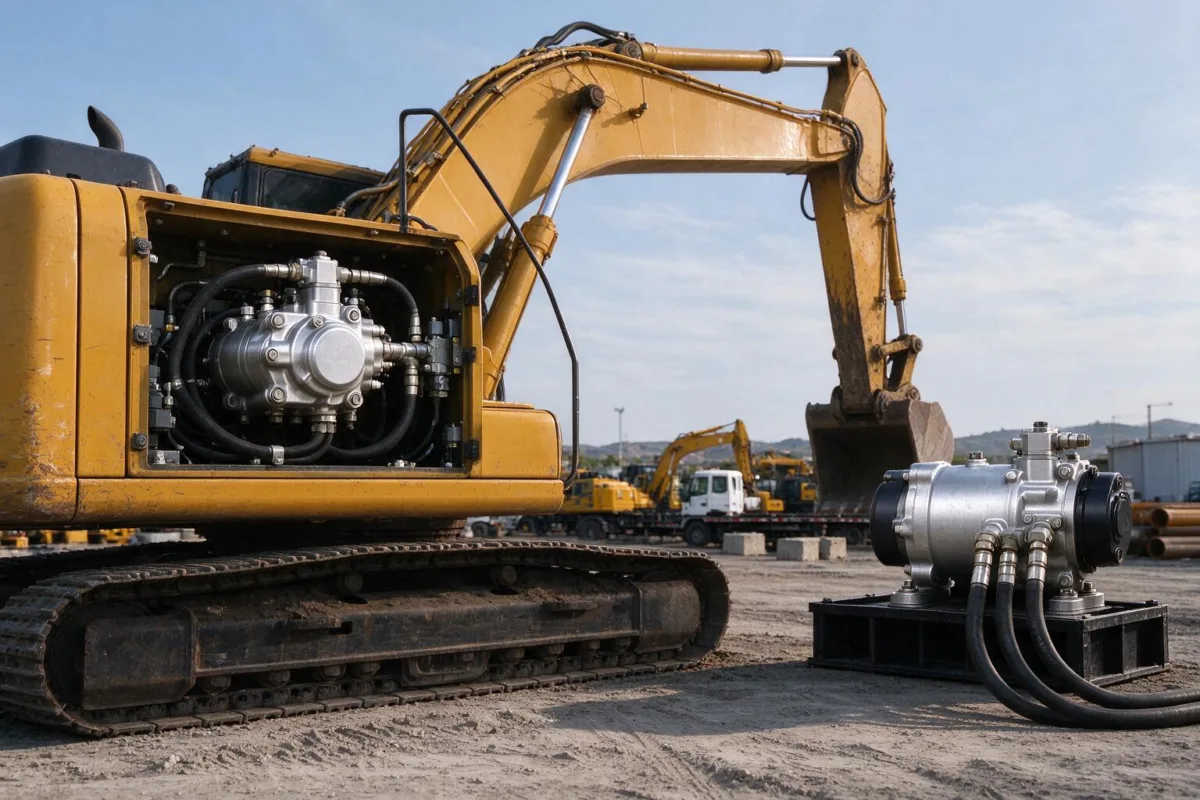
This guide addresses hydraulic pumps fitted to Liugong crawler excavators, with primary attention to the medium and large series used in earthmoving, quarrying, and utility work. Because buyers in this segment most often ask about the Liugong excavator hydraulic pump price, the content focuses on price structure and procurement decisions for replacement pumps rather than new-machine specification. Typical machines in this scope include the 20-tonne to 50-tonne class carriers, where main pumps are sized to deliver 2 × 120–280 L/min at working pressures of 32–35 MPa. Smaller utility-class units are referenced only where pump families overlap. Three pump categories are covered:
- Piston pumps — variable-displacement axial piston main pumps, often in tandem configuration, with regulators for flow and power control.
- Gear pumps — fixed-displacement units typically used for pilot, charge, or auxiliary circuits.
- Control-valve-integrated assemblies — pump packages supplied with regulator blocks, solenoid valves, or load-sensing controls already fitted.
The guide is intended for fleet maintenance managers, independent repair shops, and parts distributors who evaluate quotes across multiple suppliers. It explains how core exchange, re
Liugong Excavator Series and Typical Pump Configurations
Liugong excavator model ranges map broadly to three hydraulic pump architectures, each tied to machine tonnage and duty cycle.
Compact and small series (roughly 6 to 13 t class)
Machines in this class, including models such as the 906, 908, 910, and 913, commonly use single or tandem variable-displacement axial piston pumps. Many configurations integrate a small gear pump on the same housing to supply the pilot circuit and cooling fan. Displacement per pump body is generally modest, and control is typically mechanical or electro-hydraulic with a simple regulator.
Medium series (approximately 20 to 30 t class)
The 920, 922, 925, and 930 class typically use two main piston pumps in a tandem arrangement sharing a common regulator block, with a separate pilot gear pump. This layout supports combined flow for boom and arm functions and allows power-summing control across both pump halves.
Large series (35 t and above)
Models from the 935 class upward use high-displacement tandem piston pumps with electronic or hydraulic power control. These machines carry dedicated swing and travel circuits, so the main pump assembly is often complemented by a separate swing pump or an integrated swing section.
Part number variation
Model prefixes and suffixes indicate generation and market variant (for example, regional emissions configurations or updated control systems). The same tonnage class can therefore carry different pump part numbers across production years, even where the basic architecture is unchanged.
Pump Types and How They Affect Price
The price of a hydraulic pump for a Liugong excavator is determined largely by pump architecture and control type, not displacement alone. Buyers comparing quotes for the same model series should confirm which configuration each price refers to.
Control Type and Tolerances
Axial piston pumps with load-sensing or negative-flow control carry higher prices than fixed-displacement gear pumps. The regulator assembly adds machined components, springs, and spool valves, and the rotating group requires tighter tolerances on the cylinder block, pistons, and swashplate. Gear pumps have fewer precision parts and no variable control, which keeps their cost lower.
Single vs. Tandem Assemblies
Tandem assemblies cost more than single pumps of equal displacement. The common center section, drive coupling, and matched regulator set add machining and assembly time, and the two pump stages must be flow-matched as a pair. A tandem unit cannot be replaced by two independent single pumps without changes to the mounting and plumbing.
Pumps Supplied with Control Blocks
Pumps supplied with an assembled control valve block or proportional solenoid reduce installation labor but raise unit price. The valve block, solenoid, and wiring harness are included in the unit cost, while field installation time and the risk of mismatched settings are reduced.
Three Price Tiers
Genuine OEM pumps, OEM-equivalent aftermarket units, and rebuilt pumps form three distinct price tiers for the same part number. The table below summarizes typical positioning.
| Tier | Typical Price Position | Notes |
|---|---|---|
| Genuine OEM | Highest | Original part number, factory regulator settings |
| OEM-equivalent aftermarket | Mid | New unit, compatible part number, verify regulator calibration |
| Rebuilt | Lowest | Core exchange or outright, warranty terms vary |
Rebuilt pricing depends on core availability and the condition of the rotating group and regulator.
Main Price Drivers
Displacement and Pressure Rating
Pump price scales with displacement class and rated pressure. A higher-flow unit for a 20-tonne class machine such as the CLG920E requires a larger rotating group, heavier housing, and more substantial bearings than the equivalent pump on a 13-tonne CLG913E. Pressure rating compounds this: pumps specified for higher continuous working pressure need thicker wall sections and upgraded shaft and bearing specifications. Both factors raise material content and machining time, and both are reflected in the quoted price.
Control Type
The regulation method is a major cost variable. Simple pressure-compensated pumps sit at the lower end. Load-sensing controls, electronic proportional displacement control with solenoid valves and feedback sensors, and constant-power regulators with horsepower-limiting hardware add components, calibration labor, and test time. A pump with electronic proportional control typically carries a clear premium over a mechanically compensated unit of the same displacement.
Material and Manufacturing Source
OEM-branded units, licensed production, and independent aftermarket manufacture differ in price and traceability. Branded units carry documentation linking the part to a specific machine series; aftermarket equivalents vary widely in metallurgy, tolerances, and labeling.
Warranty and Documentation
Units supplied with bench test reports, flow and pressure curves, and a defined warranty period are priced above unverified stock. The documentation represents real testing cost.
Order Volume and Landed Cost
Volume breaks, shipping weight, and duty treatment affect cross-border landed cost. A complete pump assembly is heavy; freight and import charges can be a meaningful share of the total.
| Driver | Effect on Price |
|---|---|
| Displacement and pressure class | Higher flow and pressure raise cost |
| Control type | Electronic and load-sensing add cost |
| Source and traceability | Branded units priced above unverified stock |
| Warranty and test reports | Documented units priced higher |
| Volume, freight, duty | Affect landed cost |
Indicative Price Ranges by Class
Pricing for Liugong excavator hydraulic pumps varies widely by machine class, pump architecture, and supply tier. The figures below are indicative ranges used for budgeting; actual quotes depend on model series, configuration, and supplier.
Small-Class Single Piston Pumps
Small-class machines (roughly the 9018 to 915 range) typically use single piston pumps. Aftermarket units sit at the entry tier. OEM-equivalent pumps occupy the mid tier, generally reflecting tighter tolerance control and documented testing. Genuine branded pumps form the upper tier and carry a premium for traceability and warranty terms.
Medium-Class Tandem Piston Assemblies
Medium-class machines (approximately the 920 to 936 range) use tandem piston assemblies, and this class shows the widest price spread. Two factors dominate: the regulator type (mechanical, electro-hydraulic proportional, or load-sensing) and whether a pilot pump is included in the assembly. A tandem unit with an integrated pilot pump and calibrated regulator can price well above a bare pump pair.
Large-Class High-Displacement Pumps
Large-class machines (950 and above) carry the highest unit cost. Quotes frequently come with core-exchange or rebuild options, since new high-displacement units represent a significant spend.
Rebuilt and Exchange Units
Rebuilt pumps typically price below new aftermarket units. Suppliers generally require a verified core in rebuildable condition and a documented test bench result, including flow and pressure figures at rated conditions.
Quote Checklist
Quotes should state explicitly whether the price includes the pilot pump, the coupling, and regulator calibration. Omitting these items from a comparison can distort the delivered cost by a meaningful margin.
| Class | Pump Type | Typical Tier Structure |
|---|---|---|
| Small | Single piston | Aftermarket entry, OEM-equivalent mid, genuine upper |
| Medium | Tandem piston | Widest spread; regulator type and pilot pump drive price |
| Large | High-displacement | Highest cost; core-exchange and rebuild options common |
Identifying the Correct Pump for a Machine
Pump selection on a Liugong excavator begins with two identifiers: the machine serial number and the pump nameplate. The serial number, stamped on the frame plate, determines the production range and the parts catalog variant that applies to that unit. The nameplate on the pump itself carries the manufacturer model code, displacement in cc/rev, and rotation direction, typically stated as clockwise or counterclockwise when viewed from the shaft end. Rotation direction is a hard constraint; a pump built for the opposite rotation will not lubricate or regulate correctly.
The Liugong parts catalog entry should be matched to the serial range, not the sales model alone. A 922E built in one production year may carry a different pump than a machine with the same decal in a later batch, and catalog lookups keyed only to the model designation can return the wrong assembly. Record the serial prefix and confirm the catalog break point before quoting.
Before ordering, verify four physical interfaces: mounting flange pattern, shaft spline count and profile, port positions and thread sizes, and regulator orientation relative to the mounting face. These vary between pump families even where displacement is identical.
Finally, confirm the hydraulic architecture. Some machines use a single main pump with a priority valve feeding the pilot circuit; others use a true tandem configuration with two pump sections on a common shaft. The two arrangements are not interchangeable, and the tandem unit carries a different part number and price tier.
Distinguishing Genuine, OEM-Equivalent, and Rebuilt Pumps
Price differences between hydraulic pump listings for Liugong excavators (915E, 922E, 933E, and comparable series) often trace back to unit provenance rather than condition alone. Buyers should classify each offer before comparing cost.
Genuine units carry the manufacturer’s branding on the housing, a legible nameplate with model and part number, and a serial number traceable through the authorized dealer channel. The nameplate data should match the pump displacement and regulator configuration specified for the machine series.
OEM-equivalent units may share the same casting and rotating group as the genuine pump but commonly differ in regulator calibration and quality documentation. Regulator settings affect flow compensation and power shift behavior; a unit calibrated to a different spec can alter cycle times and load on the main control valve. Request calibration records and material certifications rather than relying on external appearance.
Rebuilt pumps should be supplied with a test report showing flow, pressure, and case drain leakage at rated conditions. Case drain leakage is the key wear indicator for the rotating group; a report without measured values at rated pressure and speed is incomplete.
Warning signs include:
- Missing or re-stamped nameplates, particularly stampings that overlap or show grinding marks
- Mismatched paint over machined surfaces such as the mounting flange or shaft splines
- Absence of port protection caps on new stock, which suggests prior installation or open storage
| Category | Identification | Documentation |
|---|---|---|
| Genuine | Manufacturer branding, legible nameplate, traceable serial number | Dealer channel records |
| OEM-equivalent | Shared casting and rotating group | Regulator calibration sheet, material certs |
| Rebuilt | Tested assembly, often with replaced rotating group | Flow, pressure, case drain leakage report at rated conditions |
Procurement Checklist and Cost of Ownership
Hydraulic pump pricing for Liugong excavators varies widely by model series and configuration, so a structured procurement process is necessary to compare offers on equal terms. The following checklist supports that comparison.
Quote Documentation
Each quote should specify in writing the pump model code, displacement, control type (for example, negative flow control or load sensing, as applicable to the machine series), and included accessories such as solenoid valves, regulators, and fittings. Quotes that omit these details are difficult to compare and may conceal configuration differences that affect fitment.
Landed Cost
Unit price alone understates the real outlay. Landed cost should include freight, import duty, and core return charges where an exchange unit is supplied. A lower unit price with high freight or an uncredited core can exceed a higher quoted price with favorable logistics terms.
Warranty and Claim Process
Warranty duration and the claim process should be weighed against the price gap between tiers. A longer warranty with a documented, low-friction claim procedure can offset a higher purchase price, particularly on machines operating in abrasive or high-duty applications.
Rebuild and Exchange Options
For high-hour machines where the housing and control block remain serviceable, rebuild or exchange programs are often the more economical route. Suitability depends on inspection of the housing, control block, and rotating group.
Pump Life and Contamination Control
Pump life should be tracked against hydraulic oil cleanliness and filter change intervals. Contamination is a primary cause of repeat failure and directly inflates total cost of ownership.