
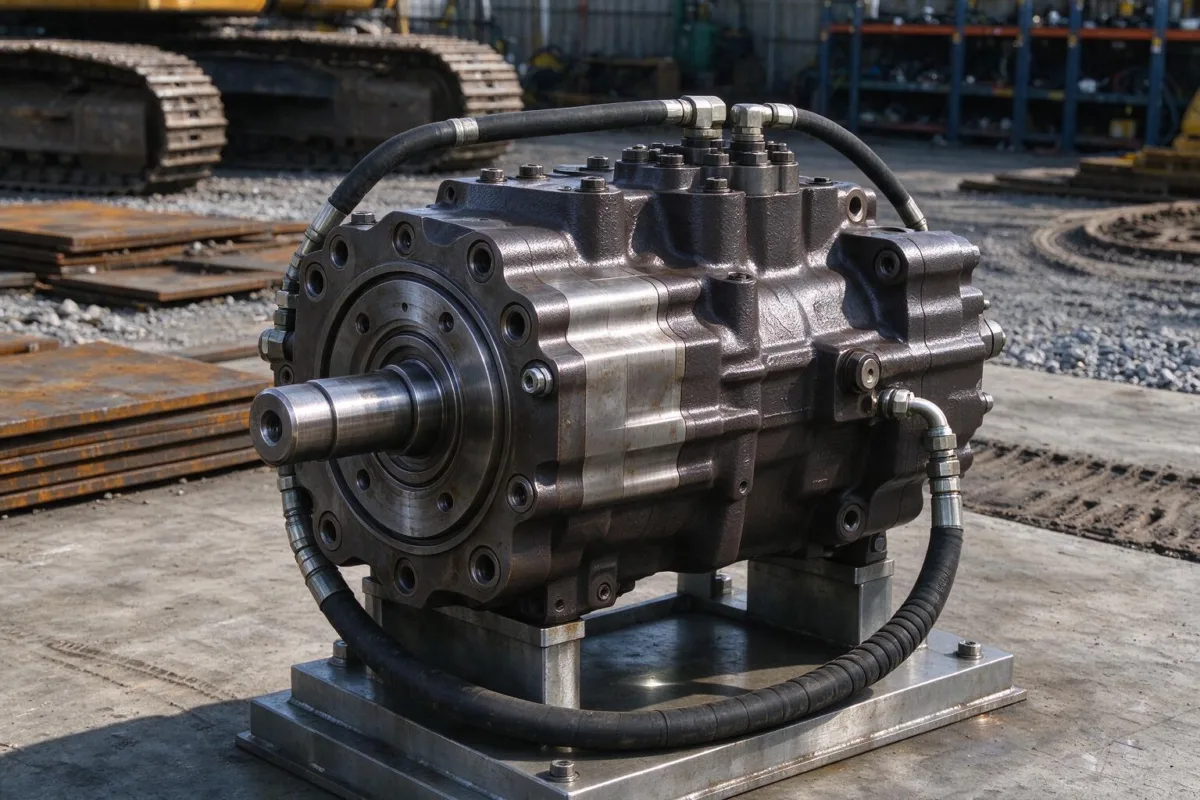
Any discussion of XCMG excavator hydraulic pump price has to start with the fact that these pumps are not a single commodity. The XCMG excavator hydraulic pump price for a 20-ton class machine such as the XE215 differs from that for a 50-ton class unit such as the XE490 in displacement, control type, and housing dimensions. Displacement per revolution, maximum working pressure, and the regulator or control block configuration all change with machine class, and each variation carries its own cost base.
Matching the Pump to the XCMG Model Series
XCMG excavator families span three broad classes, and hydraulic system architecture differs across them. Small machines (XE15–XE80) typically use compact gear or single axial piston pumps with integrated controls. Medium (XE135–XE265) and large (XE300–XE700) classes commonly use variable-displacement axial piston pumps, frequently arranged in tandem or paired with a dedicated swing pump. Pump displacement, control type, and circuit layout vary by class, so a unit specified for one family should not be assumed to fit another.
Model designation alone is not sufficient for ordering. XCMG has revised hydraulic layouts across production years, and a pump listed for an early XE215 may not fit a later unit of the same designation. Serial number breaks determine which pump variant was installed at the factory. Buyers should confirm the exact model and serial number range with the machine’s data plate before requesting pricing.
The pump nameplate carries the data needed for an accurate quote. Before contacting a supplier, record the following:
| Nameplate Field | Example Format | Purpose |
|---|---|---|
| Pump model code | Manufacturer-specific alphanumeric | Identifies exact variant |
| Displacement | cm³/rev per section | Confirms flow rating |
| Rotation direction | Left or right hand | Determines mounting compatibility |
| Control type | Load sensing, negative flow, etc. | Matches machine hydraulics |
| Serial or lot number | Numeric code | Tracks production revisions |
Photographs of the nameplate and the pump mounting flange reduce misidentification risk. Pricing for XCMG hydraulic pumps varies with displacement, control configuration, and whether the unit is a complete assembly or a rotating group, so nameplate data should be collected before any price comparison.
OEM, OEM-Equivalent, and Aftermarket: Price Tiers
Hydraulic pump pricing for XCMG excavators separates into three broad tiers, and the spread between them is substantial.
Genuine OEM
Genuine OEM pumps carry the highest purchase price. They arrive with traceable part numbers that map to the specific machine series, whether XE215C, XE370, or XE490. Documentation typically includes the longest warranty coverage of the three tiers. For mixed-fleet operators and machines under extended service contracts, the traceability simplifies warranty claims and parts audits.
OEM-Equivalent
OEM-equivalent pumps are built by established hydraulic manufacturers to match the original displacement and pressure specifications. A pump rated for the same flow at the same working pressure can cost meaningfully less than the genuine unit. Buyers should confirm the pressure rating, control type (negative flow control, positive flow control, or load sensing), and mounting interface against the machine’s specification sheet before ordering. Equivalence claims vary by supplier, so the datasheet matters more than the label.
Aftermarket and Reconditioned
Aftermarket and reconditioned pumps sit at the low end of the price range. Quality varies widely across this tier. Reconditioned units may use new rotating groups with reused housings, and aftermarket new-builds may substitute different material specs. Pressure ratings and material specifications should be verified against the OEM figures rather than assumed.
Total Cost Considerations
A lower purchase price does not always lower total cost. A pump that fails early, or that mismatches the machine’s control electronics, can trigger repeat labor, downtime, and secondary damage to valves and cylinders. On electronically controlled XCMG models, pump solenoids and controller communication must be compatible, not merely dimensionally similar. The lowest-risk approach is to compare delivered cost over the expected service interval, not the invoice price alone.
Specifications That Justify a Price Difference
Hydraulic pump pricing for XCMG excavators tracks measurable specifications rather than brand labels alone. Buyers comparing aftermarket and OEM-equivalent units should verify the following parameters against the machine’s model series and hydraulic schematic.
Pressure Ratings
Rated pressure and peak pressure ratings determine whether a pump suits the machine’s relief settings. A pump rated below the main relief valve setting of the host machine, such as a unit intended for a smaller tonnage class, will suffer shortened service life or immediate failure under load. Peak pressure ratings, typically expressed for intermittent duty, must align with the pressure cut-off settings in the main control valve. Pumps with higher rated pressure capability generally carry a higher price because of heavier wall sections and upgraded internal components.
Displacement and Control Method
Displacement in cc/rev must match the flow requirements of the machine’s actuators and travel motors. Control method is equally significant: negative flow control, positive control, and load sensing systems are not interchangeable. A pump configured for negative flow control will not function correctly on a machine with a load-sensing main valve. Regulator complexity, including horsepower limiting and torque control, adds cost, and units with multi-function regulators command higher prices than fixed-displacement or simple compensator designs.
Materials and Finish
Housing material, piston and cylinder block finish, and seal grade influence durability and cost. Forged or high-grade cast housings, lapped cylinder block surfaces, and piston shoes with bronze or polymer coatings resist wear in high-duty cycles. Seal grade, including compatibility with biodegradable or fire-resistant fluids, affects both service life and price.
Electronic Control
Electronic control interfaces, where fitted, add cost and require matching to the machine’s ECU. Proportional solenoid regulators, pressure sensors, and CAN-based communication must correspond to the controller calibration of the specific XCMG model series.
| Specification | Lower-Cost Unit | Higher-Cost Unit |
|---|---|---|
| Rated pressure | Below machine relief setting | Matches or exceeds relief setting |
| Control method | Fixed or simple compensator | Negative flow, positive control, or load sensing |
| Cylinder block finish | Standard ground | Lapped, coated wear surfaces |
| Electronic interface | None | Solenoid regulator with ECU matching |
How to Tell a Genuine Pump from a Counterfeit
Counterfeit hydraulic pumps for XCMG excavators are common in the aftermarket and are often priced well below genuine units. Because pump pricing is closely tied to authenticity, buyers should verify the unit itself rather than rely on the seller’s description.
Nameplate and Identification
The nameplate is the first checkpoint. On genuine units, the font is consistent and legible, the part number follows the format used in XCMG documentation for that specific model series (for example, the XE215C or XE370C), and the serial number encoding matches the manufacturer’s records for the production period. Counterfeit plates frequently show mismatched fonts, altered digit spacing, or part numbers that do not correspond to the machine’s serial range. Cross-reference the plate data against the parts catalog for the exact model before purchase.
Casting and Machining Quality
Inspect the pump housing and port areas. Genuine castings have uniform wall thickness, clean parting lines, and consistent surface finish. Counterfeit units often show porosity, rough castings, and inconsistent thread cutting at the inlet and outlet ports. Machining marks on mating surfaces should be regular; irregular tool marks or hand-finished surfaces indicate rework or low-volume production. Check the regulator and control valve mounting faces for flatness and fastener thread condition.
Packaging, Labels, and Authorization
Genuine pumps ship in packaging with anti-counterfeit labels, correct model labeling, and sealed components. Where available, confirm the supplier’s authorization status and request traceability documentation linking the serial number to the shipment.
Test Data
Request unit-specific test data: pressure hold, flow at rated displacement, and internal leakage values. Generic catalog claims do not verify a specific pump. A supplier unable to provide test results for the actual unit should be treated with caution.
Factors That Move the Quoted Price
A quotation for an XCMG excavator hydraulic pump is not a single fixed figure. Several variables shift the number, and buyers comparing offers should normalize for each before drawing conclusions.
Configuration
A bare pump assembly prices differently from a pump supplied with a regulator, control valve, or coupling. Main pumps on XE-series machines often ship as a complete unit with the regulator and solenoid proportional valves mounted; a stripped pump without those components carries a lower unit price but requires the buyer to transfer or source controls separately. Couplings, mounting flanges, and pilot fittings also affect the figure.
Warranty and Documentation
Warranty length and scope move the quote. A 6-month exchange warranty and a 12-month warranty with wear-part exclusions are not equivalent. Inclusion of a bench test report, flow and pressure curve at rated displacement, and relief valve setting verification adds cost but reduces installation risk.
Freight, Duties, and Packaging
Cross-border shipments add freight, import duties, and export-grade packaging, typically foam-lined wooden cases for pumps above 30 kg. Incoterms determine who bears each element; FOB and DDP quotes are not directly comparable.
Order Quantity and Stocking
Single-unit supply carries a higher per-unit price than a stocking order. Buyers maintaining inventory for a fleet typically negotiate tiered pricing.
Lead Time
Expedited supply, whether by air freight or priority allocation from stock, generally carries a premium over standard lead time.
| Variable | Typical Price Effect |
|---|---|
| Bare pump vs. pump with regulator and valves | Lower vs. higher |
| Extended warranty and test reports | Higher |
| DDP vs. FOB terms | Higher vs. lower |
| Single unit vs. stocking order | Higher per unit vs. lower |
| Expedited lead time | Premium |
Evaluating a Supplier Before Committing
Price alone does not establish whether a hydraulic pump quote is sound. Before committing to an order for an XCMG excavator main pump, buyers should verify the supplier’s ability to match the part to the correct machine configuration.
Identification by model and serial break. XCMG excavators within a series (XE215, XE370, and similar) can carry different pump assemblies depending on production period and serial number range. A supplier should be able to identify the pump by XCMG model and serial break, not by a generic photograph. Requests for the machine’s model plate and serial number are a reasonable first step; a supplier that treats all units in a series as identical may ship an incompatible pump.
Origin and part number. Ask for the manufacturer’s name and the part number of the pump being quoted. Pumps may originate from the OEM, from a licensed supplier, or from an aftermarket producer. A supplier that cannot state the origin of a pump represents a procurement risk, since material quality, internal clearances, and regulator settings vary between sources.
Returns, warranty, and test data. Confirm the return policy, the warranty duration, and whether test data accompanies the shipment. Flow and pressure test records at the pump outlet allow the buyer to verify performance against specification before installation.
Quote comparison. Obtain at least three quotes on identical specifications: same pump model, same displacement, same control type, and same origin category. This establishes a realistic price band and exposes quotes that are either implausibly low or inflated.
Practical Buying Checklist
A structured inquiry reduces the risk of receiving a pump that does not match the machine or the application. The following steps apply to XCMG excavator models across the XE series, from compact units to large crawler machines.
Identification and Nameplate Data
Record the machine model, serial number, and the existing pump nameplate data before contacting any supplier. The nameplate typically lists the pump manufacturer, part number, displacement, and maximum pressure. Where the plate is illegible, photographs of the pump housing, mounting flange, and port arrangement help confirm identity. Serial number ranges matter because XCMG has revised pump specifications across production runs of the same model.
Technical Specification
The inquiry should state displacement in cc/rev, pressure rating for both continuous and peak duty, control type (negative flow control, positive flow control, or load sensing), and rotation direction viewed from the shaft end. Control type is frequently mismatched and directly affects machine response and fuel consumption.
Supply Option
Genuine, OEM-equivalent, and reconditioned pumps differ in cost and expected service life. High-duty-cycle machines generally justify genuine or OEM-equivalent units, while reconditioned pumps may suit low-hour or backup equipment. The decision should reference the machine’s annual operating hours and remaining service life.
Quote Documentation
Each quote should include written warranty terms, bench test data (flow and pressure at rated conditions), and return policy. Test data confirms the pump met specification before shipment.
Installation Costs
The budget should account for installation labor, line flushing, and hydraulic oil replacement alongside the pump price. Contaminated oil from a failed pump will damage a replacement unit if the circuit is not flushed.
| Item | Data Required |
|---|---|
| Machine | Model, serial number |
| Pump | Part number, displacement, pressure rating |
| Control | Type and rotation direction |
| Commercial | Warranty, test data, return terms |