
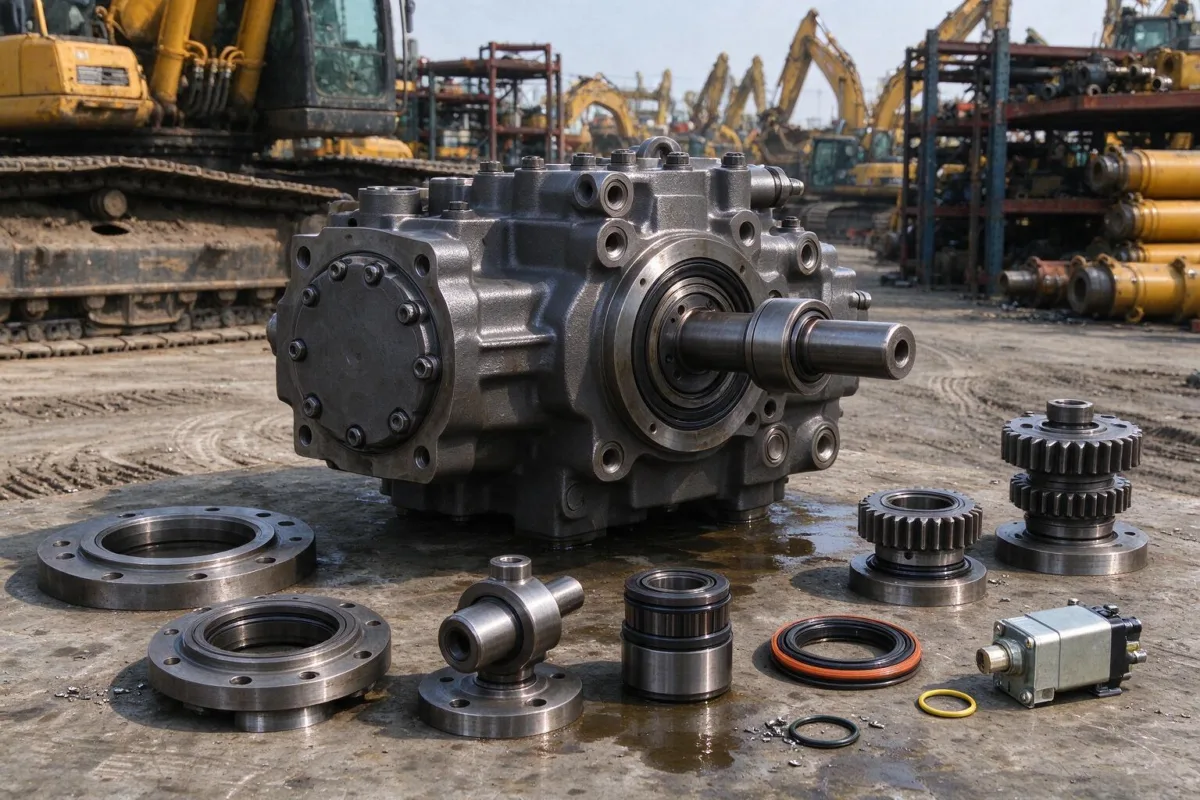
The hydraulic pump converts engine output into hydraulic flow and pressure that drive the boom, arm, bucket, swing, and travel circuits. This XCMG excavator hydraulic pump spare parts guide covers pump function, selection by tonnage class, and the main replacement categories. Because every actuator draws from this single source, pump condition directly governs cycle time and fuel consumption. A worn pump with declining volumetric efficiency forces the operator to demand more engine speed to maintain production, raising fuel burn per cubic meter moved.
Pump Configurations by XCMG Model Series
Hydraulic pump configuration varies considerably across the XCMG excavator range, and replacement parts must be matched to the specific pump arrangement rather than to operating weight alone.
Compact XE Series
Compact XE series machines typically use a single variable displacement piston pump with an integrated control block. When specifying replacement parts, displacement and control curve must match the original unit; a pump with a compatible mounting flange but a different displacement or regulator setting will not deliver the correct flow and pressure characteristics. Control valve plates, regulators, and rotating groups should be ordered against the pump model code.
Mid-Size XE Series (20 to 26 Tonne Class)
Mid-size XE series machines in roughly the 20 to 26 tonne class commonly use tandem pumps with a shared regulator. The front and rear pump sections are matched as a pair, and rotating group components such as pistons, shoes, and cylinder blocks are not interchangeable between the two sections. Parts should be identified by position (front or rear) as well as by pump model.
Large XE Series and Mining Configurations
Large XE series and mining-configuration units may use three-pump or split-circuit systems, with separate swing and travel pump groups. In these arrangements, matching by part number and pump model code is essential, since visually similar components can differ in displacement, control type, or internal clearances.
Wheeled and Specialty Variants
Wheeled excavators and specialty variants can carry pump configurations that differ from crawler equivalents of similar operating weight. Travel motor integration, auxiliary circuit demands, and regulator settings may all differ, so the machine variant and serial number range should be confirmed before ordering.
| Machine Group | Typical Pump Arrangement | Key Matching Requirement |
|---|---|---|
| Compact XE series | Single variable piston pump, integrated control | Displacement and control curve |
| Mid-size XE series (20–26 t) | Tandem pumps, shared regulator | Front/rear section position |
| Large XE / mining | Three-pump or split-circuit | Part number and pump model code |
| Wheeled / specialty | Variant-specific | Machine variant and serial range |
Reading Pump Nameplates and Part Numbers
The pump nameplate is the primary identifier for any XCMG excavator hydraulic pump assembly. A typical nameplate carries the manufacturer code, which follows recognizable patterns from Kawasaki, Rexroth, or Toshiba depending on the pump family used in a given machine series. The plate also lists displacement in cc/rev, rotation direction (viewed from the shaft end), a control type suffix, and a unique serial number. Each field matters: displacement determines flow output, rotation direction must match the engine-driven installation, and the control type suffix identifies the regulator or compensator configuration fitted to the pump.
XCMG parts catalogs index pumps by machine model and by serial number break. The same machine model can carry different pump build levels across production years, so a catalog entry that matches the model but not the serial range may point to the wrong assembly. Cross-referencing the nameplate code against the catalog entry is more reliable than relying on machine model alone. Regulator and compensator suffixes change the part number; a pump with a different control suffix is not a direct substitute even when the base pump code matches.
| Nameplate Field | Example Format | Catalog Relevance |
|---|---|---|
| Manufacturer code | Kawasaki/Rexroth/Toshiba pattern | Identifies pump family |
| Displacement | cc/rev | Confirms flow rating |
| Rotation direction | Left or right | Installation match |
| Control type suffix | Regulator/compensator code | Changes part number |
| Serial number | Unique | Locates serial break |
Before ordering, photograph the nameplate and the regulator body. Regulator variants are visually similar and often differ only by spring rating or adjustment range, so the suffix code and a clear image of the regulator casting are both needed to confirm the correct part.
Genuine, OEM-Supplier, and Aftermarket Parts
Hydraulic pump replacement parts for XCMG excavators reach the market through three distinct channels, and the differences between them matter most on rotating group components.
Genuine XCMG parts are supplied through the XCMG dealer network. They carry XCMG packaging and XCMG part numbers, and the part number is traceable to the machine serial number. This traceability is useful when a pump has been superseded across a model run, as is common on the XE215 and XE370 series.
OEM-supplier parts are produced by the original pump maker and sold under that maker’s brand. Build quality may be identical to the genuine part, but the part number and warranty path differ. A warranty claim on an OEM-supplier part is handled by the pump maker or its distributor, not the XCMG dealer network.
Aftermarket parts vary widely in metallurgy, heat treatment, and dimensional tolerances. Cylinder blocks, pistons, and swash plates are the highest-risk category: small deviations in bore geometry or surface hardness produce rapid wear, contamination, and repeat failure.
| Channel | Branding | Part number source | Warranty path |
|---|---|---|---|
| Genuine | XCMG | XCMG, serial-traceable | XCMG dealer network |
| OEM-supplier | Pump maker | Pump maker | Pump maker or distributor |
| Aftermarket | Varies | Supplier-specific | Supplier |
For high-utilization machines, the cost difference between aftermarket and OEM-supplier rotating groups is usually smaller than the downtime cost of a failed repair.
Wear Inspection and Failure Indicators
Wear assessment on XCMG excavator hydraulic pumps, including the XE series and larger units, centers on the rotating group and the condition of the hydraulic oil circuit.
Rotating Group Inspection
Cylinder block and valve plate scoring are the primary indicators for rotating group replacement. Scoring on the valve plate face or the cylinder block running surface disrupts the oil film and accelerates metal-to-metal contact. Piston slipper wear, visible as scuffing or loss of the slipper face profile, reduces the piston’s ability to maintain contact with the swashplate. Swashplate pitting on the sliding surface further degrades control response and generates debris. When these conditions are present together, replacing individual components is rarely economical, and rotating group replacement is the standard course.
Internal Leakage Indicators
Metal debris in the case drain, rising case drain flow, and declining implement speed under load all point to internal leakage beyond acceptable limits. Case drain flow should be measured against the pump’s specification at operating temperature; a steady increase over time signals wear in the rotating group or control pistons.
Shaft Seal Leakage
Shaft seal leakage at the pump input is a common failure point. Replacement requires checking shaft bearing play and the condition of the seal bore. A worn bearing or scored bore will cause a new seal to fail prematurely.
Contamination as Root Cause
Contaminated hydraulic oil is a frequent root cause of pump failure. Pump replacement without flushing the system and changing filters typically leads to repeat failure, as residual debris migrates into the new unit. Oil analysis and circuit flushing should precede any pump installation.
Compatibility and Installation Checks
Hydraulic pump replacement on XCMG excavators requires dimensional and functional verification before the unit is mounted. A pump that physically fits but differs in rotation, control logic, or porting will not perform to the machine’s specification.
Mechanical Verification
Confirm rotation direction as viewed from the shaft end. XCMG excavator pumps are typically driven clockwise or counterclockwise depending on the model series and engine configuration; a reversed-rotation pump will fail almost immediately after start-up. Check the mounting flange pattern against the original unit, including bolt hole count, spacing, and orientation. Measure the spline or keyed shaft: spline count, major and minor diameter, and engagement length must match the drive coupling. Verify the pilot diameter, since an incorrect pilot register prevents correct centering and causes shaft runout and seal wear.
Control and Porting
Confirm the control type (for example, negative flow control, positive control, or load-sensing) and the adjustment range of the regulator. A mismatched regulator alters flow sharing between the pump and the main control valve, which can produce overheating, sluggish response, or stall. Check suction, delivery, and case drain port sizes and thread types against the original pump; adapter substitutions introduce restriction and leak paths.
Post-Installation Checks
After installation, perform a case drain flow check to confirm internal leakage is within the pump’s specification. Calibrate system pressure to the machine’s published values before returning the excavator to production.
Sourcing Criteria for B2B Buyers
Purchasing hydraulic pump spares for XCMG excavators requires verifiable identification data before any quotation is accepted. Buyers should request the pump nameplate code, the machine serial number, and a photograph of the installed pump. Nameplate codes on XCMG pumps typically encode the build level and displacement, while the serial number ties the unit to a production batch. Suppliers should confirm the match in writing, referencing all three data points, so that any subsequent mismatch is documented.
Material and heat treatment specifications should be obtained for rotating group parts, including cylinder block, pistons, and valve plate. Surface hardness, case depth where applicable, and base material grade are the relevant parameters. The warranty period and the claim process should also be confirmed in writing, including what evidence is required for a claim and who bears return freight.
Buyers should confirm that individual components are available rather than complete assemblies only. Regulators, charge pumps, and seal kits are commonly replaced during partial repairs, and restricting supply to full assemblies raises cost and downtime unnecessarily.
For fleet operators, standardizing on one or two pump build levels across similar machine classes simplifies spares stocking and reduces mismatch risk. The table below summarizes the documentation to request at quotation stage.
| Item | Document requested | Purpose |
|---|---|---|
| Pump identification | Nameplate code, serial number, installation photo | Confirms correct build level |
| Rotating group | Material and heat treatment specification | Verifies durability expectations |
| Warranty | Period and claim process in writing | Defines recourse terms |
| Component supply | Availability of regulator, charge pump, seal kit | Enables partial repair |
Maintenance Practices That Extend Pump Life
Hydraulic pump service life on XCMG excavators (XE series, including XE215C, XE370C, and larger mining-class units) depends more on fluid and inlet condition than on any single component. The following practices address the failure modes most commonly seen on Kawasaki-type and XCMG-branded axial piston pumps with swashplate control.
Oil and filtration discipline
The hydraulic oil change interval and filter schedule in the machine’s service manual should be treated as a maximum, not a target. Oil sampling at 250-hour intervals for particle count (ISO 4406) and water content gives an objective basis for extending or shortening that interval. Particle counts above the cleanliness target accelerate wear on the piston slippers, cylinder block bore, and valve plate. Water content above roughly 0.1 percent promotes corrosion on the valve plate and reduces lubricity at the slipper interface.
Inlet condition
The suction strainer and breather are frequent neglect points. A restricted strainer drops absolute pressure at the pump inlet, and sustained inlet vacuum produces cavitation erosion on piston ends and valve plate kidney ports. Breather blockage raises case pressure and can force oil past shaft seals. Both items should be inspected at every filter service.
Case drain monitoring
Case drain flow measured at service intervals is a practical early indicator of internal wear. Flow rising toward the upper limit for the pump model indicates increasing clearance at the slippers, cylinder block, or valve plate, often before operators notice sluggishness or drift. Recorded values build a trend line that supports planned replacement rather than reactive failure.
Spare stock handling
Spare pumps and rotating groups should remain in sealed packaging with suction, delivery, and drain ports capped until installation. Stock should be rotated so older units are used first, preventing seal and internal corrosion degradation during long storage.