
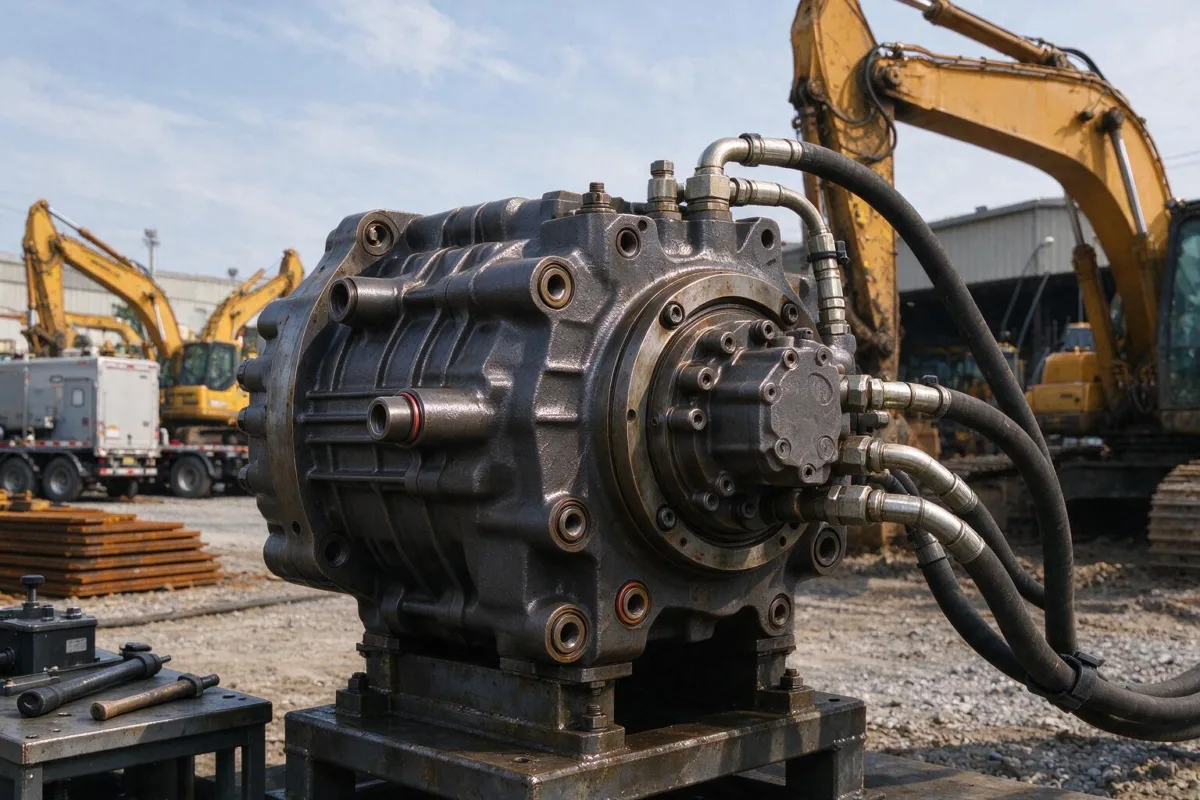
This XCMG excavator hydraulic pump buying guide begins with the XE series, which XCMG organizes into three broad classes. Because each class uses a distinct hydraulic pump platform, fitment must be assessed at the class level before individual model matching.
Mini excavators, from the XE15 through XE35, typically use single or tandem variable displacement axial piston pumps with lower displacement. These pumps are often integrated with load-sensing control, which matches the lower flow demand and compact valve blocks of small machines. Compact and mid-size units, from the XE55 to the XE215, bridge two pump approaches. The XE135 to XE215 machines commonly run tandem axial piston pumps with negative flow control or cross-sensing regulation, depending on the production generation. Earlier and later builds of the same model name can therefore carry different pump control logic.
Large machines, from the XE240 to the XE490 and above, use higher-displacement tandem or triple pump configurations. On the XE370 to XE490 class, separate swing and pilot circuits are common, so the main pump assembly is not the only hydraulic component to verify.
| Class | Model Range | Typical |
Hydraulic Pump Types Used on XCMG Excavators
Main pumps on XCMG excavators are almost universally variable displacement swashplate axial piston units. Displacement is adjusted by a regulator that responds to pilot pressure or to system demand, tilting the swashplate to vary stroke. Because output is continuously modulated rather than fixed, the regulator is as critical to pump behavior as the rotating group itself.
Tandem main pumps are common on mid-size and larger machines. Two pump sections share a common housing and drive shaft, with the front and rear sections typically feeding separate travel and work circuits. This arrangement allows independent flow to each circuit and supports combined flow during high-demand operations. Swing and pilot circuits may be served by separate gear pumps or by a dedicated small piston pump, depending on model class; smaller machines often integrate these functions differently than larger units.
Control methods vary by generation and model:
| Control Type | Typical Application |
|---|---|
| Negative flow control (NFC) | Earlier and many current production models |
| Positive flow control | Select models requiring different flow characteristics |
| Load sensing (LS) | Models with demand-matched flow requirements |
| Electronic proportional control | Newer generations with ECU-managed hydraulics |
Understanding the control type is essential when specifying a replacement. A pump with the wrong regulator will fit mechanically but deliver incorrect flow and pressure characteristics, causing sluggish operation, overheating, or stall. Confirm the control method, regulator part number, and pump series against the machine’s serial number before ordering.
Key Specifications to Verify Before Purchase
Hydraulic pump replacement on XCMG excavators requires matching several dimensional and performance parameters to the original unit. A pump that fits the mounting flange but deviates in displacement or control logic will cause poor cycle times, overheating, or damage to downstream components.
Hydraulic Performance Ratings
Rated displacement per pump section, expressed in cc/rev, must match the original unit exactly. On tandem pumps, the front and rear sections may differ in displacement, so each section must be verified separately rather than assuming a single rating applies to the whole assembly.
Rated pressure and maximum relief pressure settings differ by circuit. On mid-size machines, main work circuits typically operate in the 30 to 35 MPa range, while pilot and auxiliary circuits run at lower settings. Confirm that the replacement pump’s relief configuration matches the circuit-specific values in the machine’s specification.
Maximum flow output at rated engine speed determines cycle times and must align with the machine’s original hydraulic layout. A pump with correct displacement but different compensator settings can still deliver incorrect flow under load.
Control and Fitment Dimensions
Control regulator type, pilot pressure range, and adjustment screw configuration must match the machine’s control valve and ECU logic. Electronic and hydraulic control variants are not interchangeable without corresponding changes to the control system.
Fitment-critical dimensions include mounting flange pattern, spline or keyed shaft dimensions, and port sizes and thread types. Rotation direction and drive shaft length are common sources of misinstallation on aftermarket units and should be confirmed against the original before installation.
Genuine, OEM-Supplier, and Aftermarket Pump Identification
Genuine XCMG parts carry part numbers traceable to the machine serial number. When ordering, the machine model and serial number allow a dealer to confirm the correct pump variant, since XCMG used different pump configurations across the XE series (for example, XE215 and XE370 machines) and within production runs. The pump nameplate typically lists the part number, displacement, and a production code. These three fields should be recorded before any replacement is ordered.
OEM-supplier pumps are built by hydraulic component manufacturers and may carry both the supplier’s model code and an XCMG part number. These units are functionally identical to genuine pumps, since they come from the same production line. A nameplate showing a supplier model code alongside an XCMG part number is normal and does not indicate a non-genuine unit.
Aftermarket pumps range from supplier-equivalent rebuilds to low-cost copies. The latter frequently differ in regulator calibration and internal clearances, which affects flow response, pressure cut-off behavior, and service life. Visual inspection is the primary check:
| Check point | What to look for |
|---|---|
| Nameplate | Manufacturer mark, model code, serial number; legible and consistent with the machine |
| Housing castings | Cast-in supplier marks and part numbers on the main housing |
| Regulator | Regulator casting numbers matching the expected supplier design |
| Solenoid connectors | Connector type and pin count consistent with the machine harness |
The absence of a legible nameplate on a used unit is a risk indicator. Cast housing markings, regulator casting numbers, and solenoid connector types help confirm whether a unit is a genuine supplier build or a copy.
Inspection Checklist for Used and Rebuilt Pumps
A used or rebuilt hydraulic pump for an XCMG excavator should be evaluated on measurable condition, not appearance alone. The following checks apply to main pumps on common series such as the XE215C, XE265C, and XE370C, which typically use variable-displacement axial piston pumps with swashplate control.
Mechanical Condition
Inspect the drive shaft spline for wear, fretting, or rounded teeth. Spline wear often indicates misalignment between the pump and the engine PTO or a history of overload, and a worn spline can fail shortly after installation even if the pump itself tests well. Check the swashplate and slipper surfaces through the regulator port or against the disassembly report for scoring, discoloration, and slipper shoe wear. Heat discoloration on the swashplate suggests oil starvation or excessive case pressure.
Regulator and Test Data
Review regulator spool and spring condition. Contaminated or sticking spools cause erratic flow and are frequently misdiagnosed as pump failure, so a regulator that moves freely and returns cleanly is a meaningful indicator. Request pressure and flow test data from the rebuilder, including leakage at rated pressure, rather than relying on visual condition alone.
| Check | Acceptable Result |
|---|---|
| Shaft spline | No fretting, rounded teeth, or step wear |
| Swashplate and slippers | No scoring or heat discoloration |
| Regulator spool | Free movement, no contamination |
| Test data | Flow and leakage within OEM spec at rated pressure |
| Seals and bearings | Documented replacement |
Confirm seals, gaskets, and bearings were replaced, and identify whether the unit was rebuilt to OEM tolerances or reconditioned to a lower standard. Verify the regulator is set to the machine’s specified pressures before installation to avoid overloading the hydraulic system.
Common Failure Modes and Their Pump Implications
Most axial piston pump failures on XCMG excavators trace back to one of four system conditions. Understanding each helps determine whether a replacement pump alone will resolve the problem.
Contamination
Contamination is the leading cause of axial piston pump failure. Abrasive particles suspended in the hydraulic oil accelerate wear on slippers, valve plates, and cylinder bores. As clearances open, volumetric efficiency drops and the pump loses pressure under load. Debris that reaches the slipper-to-swashplate interface can score surfaces and cause sudden seizure. On XE-series machines, worn piston shoes and scored valve plates are typical findings in high-hour pumps operating with degraded filtration.
Cavitation
Cavitation from restricted suction lines, a clogged suction strainer, or aerated oil produces pitting on valve plate and slipper surfaces. Collapsing vapor bubbles erode metal and reduce volumetric efficiency. Persistent cavitation also generates noise and vibration that can damage the pump’s rotating group.
Overpressure
Overpressure from a failed main relief valve or an incorrect regulator setting causes swashplate and bearing damage. The rotating group is designed for a defined pressure ceiling; sustained operation above it overloads the swashplate pivot and shaft bearings, often producing catastrophic failure rather than gradual wear.
Overheating
Overheating degrades oil viscosity and accelerates internal leakage. It frequently presents as slow operation, weak digging force, or sluggish cycle times rather than an obvious pump failure, which can delay diagnosis.
When replacing a failed pump, the hydraulic system should be flushed and filters replaced. Installing a new pump into a contaminated system repeats the failure. Inspection of the suction line, relief valve settings, and oil cooler condition should accompany any pump replacement.
Matching Pump to Machine Application and Duty Cycle
Pump selection should follow the machine’s actual duty cycle rather than the purchase price alone. Excavators used in high-cycle work such as trenching, rock breaking, or continuous mass excavation run the main hydraulic pump close to maximum pressure for much of the shift. In these conditions, OEM-tolerance rebuilds of the original pump are generally the better choice, because internal clearances, valve plate geometry, and regulator calibration are restored to the specification the machine was designed around. Low-cost replacement units often carry looser tolerances that accelerate wear under sustained high-pressure operation.
Light-duty machines in utility, landscaping, and general site work spend more time at part load and lower oil temperature. For these applications, supplier-equivalent aftermarket pumps can be acceptable where cost is the primary constraint, provided the unit is matched to the correct displacement and control type.
Pressure rating is a key check. The pump’s rated continuous pressure should exceed the machine’s main relief valve setting, which preserves service life under sustained load. A pump rated at or below the relief setting will run at its limit whenever the circuit is loaded.
Spare parts support matters as much as the pump itself. Confirm that regulator components, control valves, and seal kits are available separately. A pump with no parts support carries higher long-term risk, since a failed regulator can otherwise require a full unit replacement.
At installation, record the pump part number and serial number in the machine’s maintenance file. This supports future identification and warranty traceability.
Purchase Process and Documentation
Accurate identification and documented confirmation are the primary safeguards against ordering an incorrect hydraulic pump for an XCMG excavator. The process begins with the machine model and serial number, which determine the applicable pump variant across production changes. The pump nameplate should be photographed in full, capturing the part number, displacement, rotation direction, and any manufacturer markings. Suppliers should confirm fitment against these details in writing before the order is placed, particularly where XCMG model series share similar pump configurations across different displacements.
Dimensional confirmation follows. Requesting drawings or photographs of the mounting flange, drive shaft (spline count, pilot diameter, and shaft length), and port positions allows cross-checking against the removed unit. Pilot diameter and flange bolt pattern are common sources of mismatch, and port orientation affects hose routing. Where available, a comparison table of the removed pump against the offered unit is useful:
| Check Item | Removed Pump | Offered Pump |
|---|---|---|
| Part number | From nameplate | Supplier confirmation |
| Displacement | cc/rev | Catalog value |
| Shaft type | Spline/pilot dimensions | Drawing dimensions |
| Mounting flange | Bolt pattern | Drawing dimensions |
| Port configuration | Size and position | Drawing dimensions |
Warranty terms should be confirmed in writing, including the coverage period and whether the regulator, solenoid valves, and control components are within scope or excluded. Shipping protection is a practical concern: the drive shaft should be secured against impact, and all port openings must be capped or plugged to prevent contamination ingress during transit. Finally, the removed pump should be retained for core return where a core exchange program applies, or reserved for rebuild assessment, as core credit terms and rebuild feasibility both depend on the original unit being available and complete.