
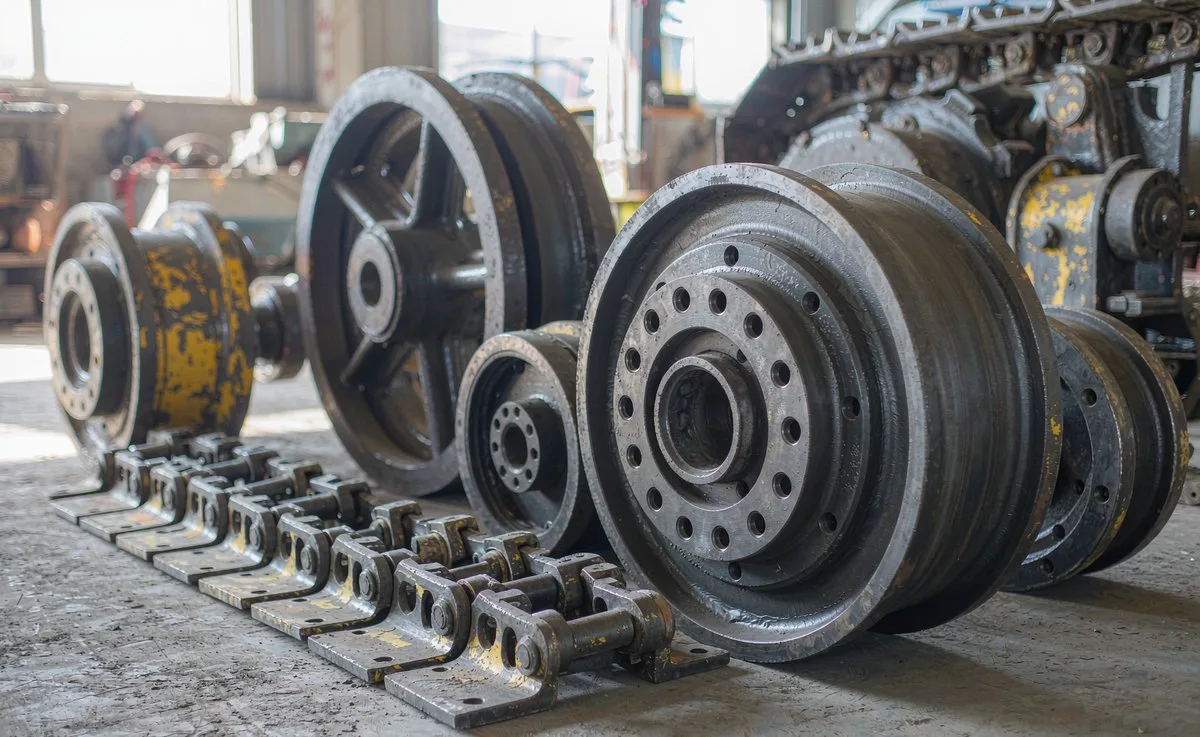
An undercarriage can absorb more than half of the lifetime maintenance budget of a 20-tonne excavator, and it is the area where the widest price spread appears between suppliers. This XCMG excavator undercarriage buying guide covers what actually wears, how to measure it before ordering, and which specification details decide whether a track group lasts 3,000 hours or 8,000 hours on the same machine.
The guide applies to the XE series used in earthmoving and quarry work, including the XE215C, XE265C, XE335C, XE370C and XE490. Part numbers differ between production batches, so every point below assumes the buyer has the machine serial number rather than only the model name.
What the Undercarriage Consists Of
| Component | Function | Typical life |
|---|---|---|
| Track rollers | Carry machine weight on the chain | 4,000 to 8,000 h |
| Carrier rollers | Support the return strand | 6,000 to 10,000 h |
| Front idler | Guides and tensions the chain | 5,000 to 9,000 h |
| Sprocket | Drives the chain | 3,000 to 6,000 h |
| Track chain and shoes | Traction and ground contact | 4,000 to 9,000 h |
| Track adjuster and recoil spring | Maintains tension | 3,000 to 6,000 h |
Life figures are for a machine working in dry, abrasive soil with correct tension. Wet clay, rock and constant travel shorten all of them, and a chain run too tight can halve roller life on its own.
Measure Before You Order
Buyers who order from a parts list alone are the ones who receive a track group that does not fit. Four measurements settle most of the risk:
- Chain pitch. Measure across four link pins and divide by three. A worn chain reads longer than nominal, and a new chain on a worn sprocket will wear out within a few hundred hours.
- Roller flange diameter and tread width. Flange wear of more than 4 mm means the roller can no longer keep the chain aligned.
- Bushing and pin wear. Turn the chain over and check for play between bushing and pin. If the bushings are turning in the links, the chain is finished regardless of remaining shoe thickness.
- Sprocket tooth profile. Compare a used tooth against a new one on the same pitch. A hooked profile accelerates chain wear even when the roller set is new.
Match the Wear Pattern, Not Only the Part Number
Uneven wear tells you what to fix along with the parts. Rollers worn on one side only suggest a bent track frame or a machine that works on a constant side slope. A single failed roller in a set usually indicates a lubrication failure rather than a load problem, and replacing it alone will be followed by the next one. Carrier rollers that fail early often sit behind an over-tightened chain.
Sprockets and chains should be replaced as a pair. Fitting a new chain onto a worn sprocket transfers the old tooth pitch into a new chain and produces rapid wear at the bushings, and the same is true in reverse. If the sprocket is more than about 30 percent worn, budget for both.
OEM, OEM-Supplier and Aftermarket
There are three realistic purchase routes for XCMG undercarriage parts, and the difference is in heat treatment rather than in dimensions.
- Genuine parts carry the manufacturer warranty and the original hardness specification. Cost is highest and lead time is predictable.
- OEM-supplier parts come from the same tier-one factories that supply the assembly line, sold under the factory’s own brand. Dimensions and metallurgy normally match, and the price is typically 20 to 35 percent lower.
- Aftermarket parts vary widely. The castings may be correct while the sealing and heat treatment are not, which shows up as seal leaks at 1,500 hours instead of 5,000.
For a machine on a single shift in soil, a good OEM-supplier set is the usual value choice. For quarry or demolition work where shock loads are constant, the hardness specification matters more than the price difference.
Seals, Lubrication and the Details Buyers Skip
Rollers are supplied as sealed-for-life, refillable or lubricated-for-life depending on the series. Refillable rollers need a defined service interval; if your workshop cannot maintain that interval, buy sealed units. Check that the seal type matches the machine’s operating conditions: standard nitrile seals are adequate in dry conditions, while machines that work in water or slurry need the heavier seal arrangement.
Also confirm what is included in the price. Track groups are often quoted without shoes, without mounting hardware and without the master pin, and the freight difference between a bare chain and a complete assembly is significant on a 20-tonne machine.
A Practical Buying Checklist
1. Record the machine serial number and the current undercarriage part numbers. 2. Measure pitch, flange wear, bushing play and sprocket profile. 3. Decide whether the chain and sprocket are replaced as a set. 4. Confirm seal type for the working environment. 5. Confirm what the quotation includes: shoes, hardware, master pin, freight. 6. Ask for the hardness specification and the warranty terms in writing.
The undercarriage is one of the few areas where a buyer can predict cost per hour with reasonable accuracy. Measure honestly, buy the specification that matches the duty cycle, and the difference between a cheap set and a correct set becomes visible long before the warranty expires.