
Construction machinery, XCMG Parts
XCMG Excavator Bucket Teeth Model Compatibility: A Comparative Review
Nov
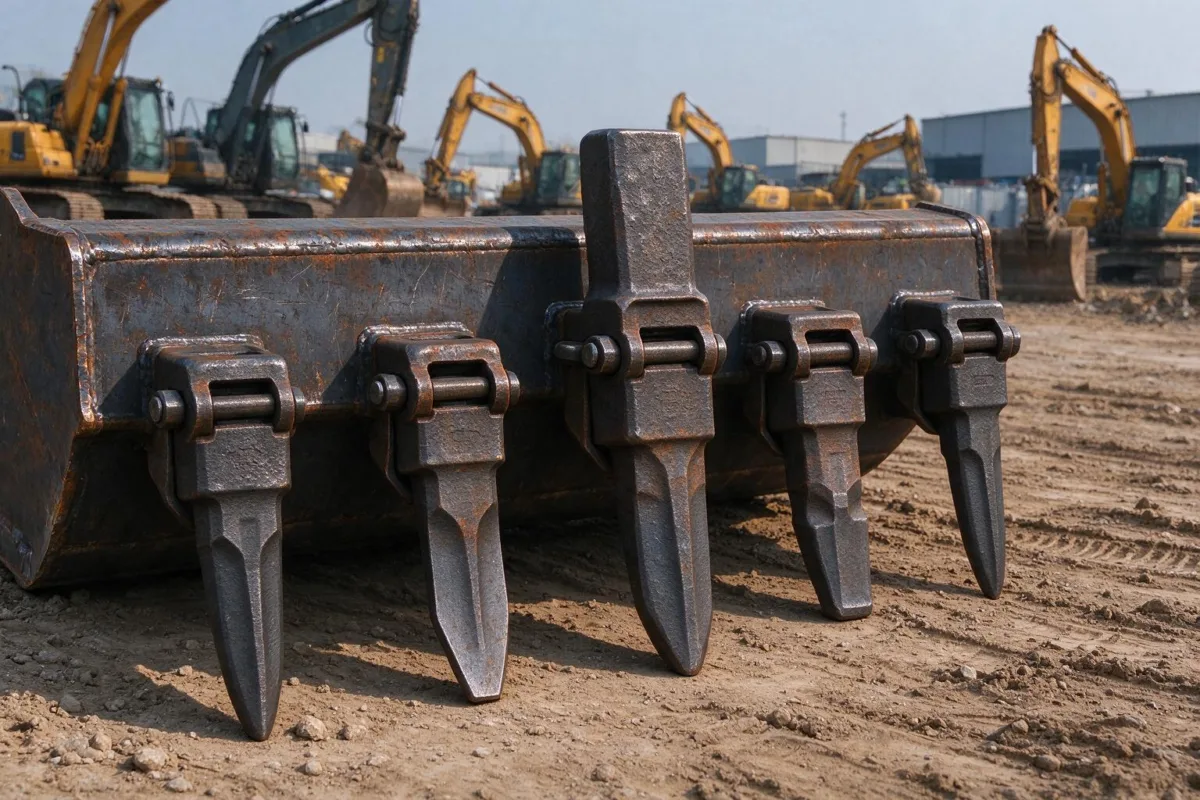
XCMG excavators use bucket teeth systems engineered for specific model series rather than a single cross-platform standard, so XCMG excavator bucket teeth model compatibility depends on matching the tooth to the correct machine series. Compatibility between a tooth and a machine is governed by three factors: the tooth adapter design, the pinning method, and the tooth profile. The adapter, welded to the bucket lip, sets the mounting interface. The pinning method (top-pin, side-pin, or hammerless twist-lock) determines how the tooth is retained. The tooth profile controls penetration and wear characteristics for the given application.
Key Compatibility Factors: Adapters, Pins, and Tooth Profiles
Bucket tooth fit on XCMG excavators depends on three interlocking elements: the adapter, the pinning method, and the tooth profile. Each must be verified before a replacement tooth is specified.
Adapters (Noses/Shanks)
The tooth adapter, also called the nose or shank, is welded to the bucket lip and defines which tooth family the bucket can accept. Adapter geometry varies across XCMG series and machine classes, so the adapter part number is the primary reference when identifying a compatible tooth. A tooth from a different adapter family will not seat correctly, regardless of nominal size.
Pinning Methods
Retention designs differ by model. Some XCMG buckets use top-mounted pins with retainers, where the pin drops vertically through the tooth and adapter and is secured by a rubber or steel retainer. Others use side-pin arrangements, with the pin driven horizontally and locked at the side. Bolt-on teeth use a threaded fastener instead of a pin. The retention method must match the adapter, since pin orientation and hole placement are not interchangeable.
Tooth Profiles
Profile selection affects penetration and wear life. Chisel teeth concentrate force for penetration in compacted material, rock teeth carry heavier wear metal for abrasive ground, and flat or blunt profiles suit bulk loading. Profile choice does not override fit: the tooth’s internal cavity must match the adapter’s external geometry.
Part Number Patterns and Aftermarket Fit
XCMG tooth part numbers often follow a pattern indicating series and size, such as 72A0001 for certain XE models. Aftermarket teeth must match the adapter’s dimensions, pin hole diameter, and retainer groove to ensure secure attachment. Dimensional checks on these three features are the practical basis for confirming compatibility.
Model Series Compatibility Comparison
Tooth fitment across the XCMG excavator range is determined primarily by bucket size, pin diameter, and lip geometry rather than by a single cross-series standard. The table below summarizes the general pattern.
| Series / Models | Tooth Type | Key Compatibility Notes |
|---|---|---|
| XE Series (XE215C, XE265C, XE370C, XE490C) | Varies by bucket size and application | Smaller models often share tooth families with larger ones but require different adapters |
| XE900D and larger mining excavators | Heavy-duty, larger pins, thicker wear surfaces | Not compatible with standard XE-series adapters |
| Compact (XE15U, XE35U) | Small pin-on | Not interchangeable with larger models |
| Wheeled (XE150W, XE210W) | Similar to tracked models of comparable size | Bucket lip geometry can differ |
XE Series
On the XE215C, XE265C, XE370C, and XE490C, tooth selection follows bucket size and application. A tooth family used on a smaller machine may also appear on a larger one, but the adapter differs to suit the bucket lip and pin arrangement, so the tooth and adapter must be matched as a set.
Mining Class
The XE900D and larger mining excavators use heavier-duty teeth with larger pins and thicker wear surfaces. These components are dimensionally distinct from standard XE-series hardware and do not interchange with it.
Compact Excavators
The XE15U and XE35U use smaller pin-on teeth sized to compact bucket lips. These are not interchangeable with teeth or adapters from larger models.
Wheeled Excavators
The XE150W and XE210W may use teeth similar to tracked models of comparable size, but bucket lip geometry can differ, so verification against the specific bucket part number is required before substitution.
Tooth Part Number Cross-Reference and Identification
XCMG part numbers for bucket teeth and adapters are typically stamped directly on the component or listed in the parts manual for each excavator model. Stamping location varies by tooth family: chisel teeth often carry the number on the shank, while adapter numbers may be cast into the side of the nose or the mounting face. Where a stamp is worn or illegible, the parts manual for the specific model (for example XE215C, XE265C, or XE370) is the primary reference, and the manual entry should be matched to the machine serial number range rather than the model designation alone.
Common XCMG tooth part numbers include 72A0001, 72A0002, and 72A0003 for standard chisel teeth. These numbers may vary by production year, and later revisions of the same tooth family can carry different suffixes. A number that appears correct for one build year may not correspond to the tooth fitted to a machine from a different production batch.
Aftermarket suppliers often publish cross-reference charts that map XCMG part numbers to their own product codes. These charts are a starting point, not a final confirmation. When cross-referencing, the adapter part number should be confirmed as well, since tooth and adapter must be compatible as a set; a tooth that fits the pin and nose of one adapter may not seat correctly on another.
Physical verification before ordering aftermarket teeth is advised:
| Check | Method |
|---|---|
| Pin hole diameter | Caliper measurement of the retainer bore |
| Tooth length | Overall length from tip to shank end |
| Nose width | Measurement across the adapter nose at the seating face |
These dimensions resolve discrepancies between cross-reference charts and the component actually installed on the machine.
Application-Specific Tooth Selection
XCMG excavator bucket teeth are matched to the digging conditions and the adapter interface on the bucket. Tooth profile and tip material determine wear rate, penetration, and the load transferred to the adapter and bucket lip.
Tooth Types by Application
Standard chisel teeth are the general-purpose option for mixed soil and clay. The chisel profile concentrates breakout force at a narrow tip, which supports penetration in compacted ground while retaining enough body mass for moderate wear. These teeth suit utility, trenching, and general site work on XE-series machines where abrasive content is low.
Rock chisel teeth with reinforced tips are intended for abrasive or rocky conditions. The reinforced tip carries additional wear material, extending service life where silica content and impact loading accelerate tip loss. These are typically specified for quarry, demolition, and weathered rock applications.
Flat teeth are used for grading and finishing work. The flat cutting edge produces a smooth bucket edge and limits gouging during final trim, backfill spreading, and slope work. They are not intended for high-impact digging.
Heavy-duty penetration teeth are designed for hard-packed materials such as compacted gravel, hardpan, and frozen ground. These teeth generate high point loading and require compatible adapters with increased strength; fitting a heavy-duty tooth to a standard adapter can overload the nose and pin retention.
Consequences of Mismatching
Using the wrong tooth type for the application leads to premature wear, tip breakage, or reduced productivity. A standard chisel tooth run in abrasive rock wears rapidly and can expose the adapter, while a flat tooth used in hard digging cannot penetrate efficiently and raises cycle times. Tooth selection should follow the bucket’s adapter series and the machine’s breakout force rating.
| Tooth Type | Application | Key Characteristic |
|---|---|---|
| Standard chisel | Mixed soil, clay | General-purpose penetration |
| Rock chisel, reinforced tip | Abrasive, rocky ground | Extended wear life |
| Flat | Grading, finishing | Smooth bucket edge |
| Heavy-duty penetration | Hard-packed material | Requires reinforced adapter |
Aftermarket vs. OEM Teeth: Compatibility Considerations
OEM bucket teeth for XCMG excavators are manufactured to the dimensions and tolerances specified for each model series, so fit is assured when the correct part number is ordered for a given machine, such as the XE210U or XE370C. Aftermarket teeth can reduce purchase cost, but the savings are only valid if the tooth matches the OEM interface: adapter nose geometry, tooth length and width, pin or retainer hole position, and the pinning method itself. A tooth that seats loosely or requires modification introduces play at the adapter, which accelerates wear on both components.
When evaluating aftermarket options, compare them against OEM specifications for base metal hardness, tip hardness, and dimensional tolerances, not only for overall shape. Hardness values that fall below the OEM range typically shorten service life in abrasive or high-impact ground, while excessive hardness can make the tooth brittle. The retention system also warrants attention: pin-and-rubber-lock, bolt-on, and flex-pin designs are not interchangeable, and a mismatched retainer can allow the tooth to work loose under load.
Some aftermarket teeth are marketed as compatible with multiple brands or model families. Actual fit can vary within those claims, so trial fitting on the adapter before committing to a full set is recommended. Warranty terms and technical support also differ between OEM and aftermarket suppliers, and these differences affect long-term cost of ownership when premature failure or fit issues occur.
For critical applications, such as production trenching or demolition work where unplanned downtime is costly, teeth that meet or exceed OEM specifications are the safer choice.
Installation and Maintenance Best Practices
Correct installation of XCMG excavator bucket teeth depends on proper pin and retainer placement. The pin must seat fully through the aligned bores of the tooth and adapter nose, and the retainer must engage its groove or locking feature as specified for the tooth system in use. A missing or incorrectly seated retainer allows the pin to migrate under digging loads, and tooth loss typically follows. Installation should follow the torque or fitment guidance for the specific tooth series, since pin and retainer designs vary across standard, rock, and heavy-duty configurations.
Routine inspection of tooth wear and pin condition is the primary defence against adapter damage. Worn pins, deformed retainers, and teeth worn beyond their service limit transfer load to the adapter nose, accelerating wear on a component that is significantly more costly to replace than a tooth. Inspections should be scheduled at intervals matched to operating hours and ground conditions, with more frequent checks in abrasive or high-impact applications.
When replacing teeth, the adapter should be inspected for wear on the nose, pin bores, and contact surfaces. Adapters showing dimensions beyond the allowable tolerances published for the model should be replaced rather than reused with new teeth.
| Check item | Action |
|---|---|
| Pin and retainer seating | Verify full engagement after installation |
| Tooth wear | Compare against service limit; replace as needed |
| Adapter nose dimensions | Measure against tolerance; replace if exceeded |
| Pin condition | Replace bent, worn, or corroded pins |
Anti-seize compound applied to pins can ease future removal, particularly in wet or corrosive conditions, but manufacturer recommendations should be followed regarding its use. A consistent replacement schedule based on operating hours and ground conditions helps avoid both premature tooth loss and unnecessary adapter wear.
Summary and Selection Recommendations
Bucket teeth for XCMG excavators are not interchangeable across the full range of machine sizes. Compatibility should be confirmed at three levels before any order is placed: the excavator model series, the adapter (tooth holder) part number, and the pinning method used to retain the tooth. A tooth that fits the adapter nose but uses a different pin or lock design may not seat correctly or may loosen under load.
The most reliable reference is the XCMG parts manual for the specific machine serial number. Serial-number breaks within a model series can change adapter part numbers and tooth profiles, so a manual entry for a similar machine is not sufficient confirmation. Where the manual is unavailable, the adapter casting number stamped on the holder itself should be cross-referenced against supplier compatibility charts.
Application requirements should guide tooth profile selection. A standard chisel tooth is a reasonable general-purpose starting point for mixed digging in soil and compacted material. Trenching, rock work, and high-abrasion conditions may call for different profiles or wear materials, and the adapter must match the selected tooth family.
Aftermarket teeth can be a viable option when they match OEM dimensions and material specifications, including nose geometry, pin hole location, and hardness. Dimensional verification against the removed tooth is advisable before committing to volume purchases.
Maintaining records of part numbers, adapter references, and suppliers supports consistency at replacement time and reduces the risk of mismatched components across a mixed fleet.
