
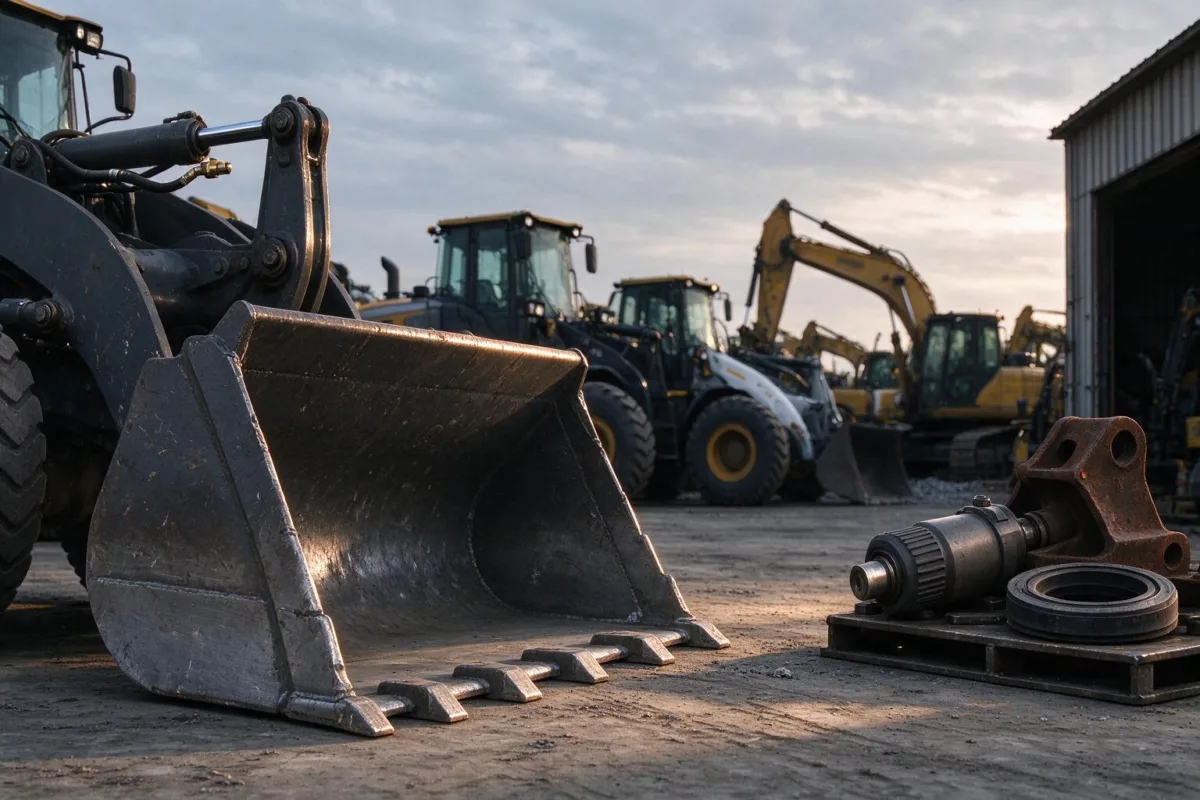
This Shangtui loader parts buying guide covers the SL series wheel loaders most commonly encountered in export and domestic markets. Before cross-referencing any component, buyers should confirm the exact model and serial number from the machine plate, since series-level identification alone is not sufficient for ordering. Model plate data, engine designation, transmission type, and axle configuration determine which parts variant fits a given machine. Two loaders sold under the same series name can carry different driveline components, particularly where production spans multiple build periods or engine supplier changes. The serial number is the most reliable key for narrowing the correct variant.
Major Assemblies and Wear-Prone Components
Shangtui wheel loaders share component categories with other Chinese-built loaders in the 3–6 tonne class, so parts are typically identified by model series (for example ZL30, ZL50, or 9-series equivalents) and by assembly rather than by individual part number alone.
Engine Parts
Filters, injectors, turbocharger assemblies, water pumps, and gasket sets are consumables with defined service intervals. Buyers should confirm the engine family (Weichai WP6/WP10, Yuchai, or Cummins-derived units depending on model) before ordering, as injector and turbo part numbers differ between emissions tiers.
Transmission and Torque Converter
Clutch packs, seals, bearings, and control valve components are the highest-value wear items in the driveline. Valve body and solenoid parts are often the first to fail before mechanical clutch wear becomes visible.
Hydraulic System
Main pumps, priority valves, cylinders, seal kits, and hoses account for a large share of unscheduled downtime. Hose assemblies should be matched by pressure rating and end fitting type, not length alone.
Work Equipment
Bucket teeth, cutting edges, pins and bushings, and lift/tilt cylinder rod ends wear according to material density and cycle count. High-abrasion applications such as aggregate handling shorten tooth life considerably compared with general earthmoving.
Undercarriage-Adjacent and Structural Parts
Axle shafts, final drive components, articulation bearings, and frame pins should be inspected for fatigue rather than replaced on a fixed schedule. Crack detection and pin/bore measurement are more reliable indicators than hour-meter readings.
Cab and Electrical
Wiring harnesses, sensors, instrument clusters, and lighting are frequently ordered for refurbishment projects. Harness part numbers vary by cab configuration, so VIN or serial number confirmation is recommended.
| Assembly | Typical wear items | Replacement basis |
|---|---|---|
| Engine | Filters, injectors, turbocharger, water pump | Service interval |
| Transmission | Clutch packs, seals, bearings, valve components | Condition and hours |
| Hydraulics | Pumps, priority valves, cylinders, hoses | Condition and leak inspection |
| Work equipment | Teeth, edges, pins, bushings, rod ends | Cycle count and material |
| Structural | Axle shafts, final drives, articulation bearings | Fatigue inspection |
Genuine, OEM-Supplier, and Aftermarket Parts: What the Labels Mean
Genuine parts are sold through the brand’s authorized distribution channel and arrive in the brand’s packaging with the brand’s part number. For Shangtui wheel loaders, that typically means a dealer network carrying components under the manufacturer’s catalogue references. Genuine parts are not the only acceptable option, but they offer the clearest traceability: the part number, packaging, and sales channel can be cross-checked against the brand’s records.
OEM-supplier parts are produced by the same tier-one supplier that builds components for the brand, sometimes on the same tooling and to the same drawing, but without brand packaging. Buyers should verify the supplier’s identity and confirm that the supplier’s part number is equivalent to the brand reference, not merely similar in appearance.
Aftermarket parts vary widely in material grade and dimensional tolerance. For hydraulic and transmission internals, tolerance deviation is the main risk factor: a few hundredths of a millimeter on a spool valve or a shaft journal can change leakage rates, shift quality, and service life.
| Label | Source | Key verification |
|---|---|---|
| Genuine | Authorized channel, brand packaging | Part number and channel traceability |
| OEM-supplier | Tier-one supplier, often unbranded | Supplier identity and part number equivalence |
| Aftermarket | Independent producers | Batch records, material and test data |
A part number alone does not guarantee origin. Buyers should request batch information, material certificates for structural parts, and pressure-test records for hydraulic components. For safety-critical items such as lift cylinder rods, steering components, and brake parts, material specifications and test requirements belong in the purchase order itself.
Visual and Dimensional Identification Checks
Visual inspection begins with a direct comparison against the original component. Casting marks, machined surfaces, and part-number stampings should be checked for position, font, and depth. Cast-in markings are more difficult to reproduce than laser-etched or painted numbers, which are easier to counterfeit and should be treated as weaker evidence of origin. Part numbers stamped into structural castings should match the format used on the reference part, including prefix and suffix conventions.
Dimensional verification covers the features that govern fit and function:
- Pin diameters and bore sizes on linkage and bucket pins
- Seal groove widths and depths on hydraulic components
- Flange bolt patterns, including hole spacing and counterbore depth
- Spline counts and major/minor diameters on transmission and pump shafts
Surface finish provides a further check. Hydraulic cylinder rods should show consistent plating with no patchiness, pitting, or polish marks. Pump internals should exhibit uniform machining patterns; irregular tool marks or inconsistent surface texture indicate lower process control.
Where handling permits, structural parts should be weighed. A significant deviation from the reference weight suggests thinner wall sections or a different material grade, even when external dimensions appear correct.
Packaging should be inspected for consistent labeling, part-number format, and protection suited to the component type. Heavy castings require crating or reinforced cartons; hydraulic assemblies require port caps and corrosion protection. Inconsistent labels or inadequate packaging are indicators of uncontrolled supply.
| Check | Method | Counterfeit Indicator |
|---|---|---|
| Casting marks | Visual comparison | Shallow or absent cast-in numbers |
| Pin and bore size | Caliper or micrometer | Out-of-tolerance dimensions |
| Rod plating | Visual, tactile | Patchy or uneven finish |
| Part weight | Scale | Significant deviation from reference |
| Packaging | Label and protection review | Inconsistent format or poor protection |
Hydraulic and Transmission Parts: Technical Selection Points
Hydraulic pump selection for Shangtui loaders begins with the machine’s original specification: displacement, rated pressure, and mounting flange pattern. A pump with a higher nominal pressure rating does not compensate for incorrect flow characteristics. If displacement is mismatched, cycle times and system relief behavior change, and the extra pressure margin provides no functional benefit. The flange bolt pattern, pilot diameter, and shaft spline must match the original before installation is attempted.
Seal kits should be selected by material compatibility with the operating oil temperature and pressure, not by price tier. Nitrile, fluorocarbon, and polyurethane compounds behave differently across temperature ranges, and a low-cost kit in the wrong material will fail early regardless of fit.
For transmission clutch plates, confirm friction material type, plate thickness, and spline configuration against the assembly drawing. Friction material affects shift quality and heat tolerance, and thickness tolerances influence clutch pack clearance.
Remanufactured pumps and torque converters can be cost-effective when the rebuilder supplies test-bench data (flow, pressure, leakage) and a defined warranty period. Without documented test results, remanufactured status is difficult to verify.
Specify filtration ratings when ordering hydraulic components. Contamination is a leading cause of repeat failures after replacement, and a correct micron rating at the return or pressure filter protects the new unit during break-in.
| Parameter | Verify Against |
|---|---|
| Pump displacement and pressure rating | Machine specification plate or service manual |
| Mounting flange and shaft spline | Original pump dimensions |
| Seal material | Oil temperature and pressure range |
| Clutch plate thickness and spline | Transmission assembly drawing |
| Filtration micron rating | System filter specification |
Sourcing and Supplier Verification
Buyers sourcing Shangtui loader parts should begin with a written product scope from each supplier. Request the range of assemblies and consumables covered, then confirm whether the supplier holds stock or sources to order. Lead time claims should be supported by inventory evidence, such as stock reports, warehouse photographs, or batch records tied to the requested part numbers. A supplier that sources every line to order will generally show longer and less predictable lead times than one carrying stock of fast-moving items.
Compatibility should be verified through documentation rather than verbal assurance. Ask for reference part numbers, OEM cross-reference lists, and drawings where available, and check these against the machine’s parts catalog. For example, confirm whether a quoted filter or seal kit cross-references to the correct part number for the specific Shangtui model series before committing to a trial order.
For repeat orders, inspection criteria and acceptance sampling should be agreed in the contract. Specify measurable characteristics, such as dimensions, hardness for seals, and filtration ratings for filters, along with the sampling plan and the handling of nonconforming lots.
Export capability merits a separate check: documentation for customs and freight, packaging suitable for sea freight, and a stated method for oversize components such as axles and buckets, including crating, lifting points, and container loading plans.
Order consolidation by assembly reduces freight cost per part. Low-value, high-volume items such as filters and seals are best grouped with the assemblies they serve rather than shipped as separate small lots.
| Verification item | Evidence to request |
|---|---|
| Stock vs. source to order | Stock report or batch records |
| Part compatibility | Cross-reference list or drawing |
| Repeat order quality | Agreed inspection criteria and sampling plan |
| Export readiness | Shipping documents and packaging specification |
Cost, Lead Time, and Inventory Planning
Effective parts planning for Shangtui loaders starts with classifying components by failure impact rather than by unit price. Three groups are useful:
- Critical parts: engine assemblies, transmission components, and hydraulic pumps and valves. A failure here stops the machine.
- Wear parts: bucket teeth, cutting edges, filters, and brake linings. Consumption is predictable and tied to operating hours.
- Structural parts: pins, bushings, and frame components. Failures are usually gradual and inspection-driven.
Stocking policy should follow this classification. Wear items with steady consumption rates justify higher stock levels, since holding cost is low relative to the risk of an unplanned stop. Critical items with long lead times warrant safety stock sized to lead-time variability, not full replacement inventories. Structural parts are typically ordered on condition.
Reorder points should be calculated from consumption per machine hour. Hour-meter data from each unit gives a consumption rate that can be converted into a reorder trigger, which is more reliable than calendar-based ordering, particularly where machines run different duty cycles.
Total cost of ownership comparisons across part tiers should include downtime cost, not just unit price. A lower-cost hydraulic pump that fails early can erase its savings through lost production hours. The same logic applies to undercarriage and GET components.
For older machines, confirm continued parts availability before committing to a long-term maintenance plan. Where a model series is being phased out, availability of engine and transmission internals can change without notice, and that risk should be factored into the replacement decision.
| Part category | Examples | Stocking approach |
|---|---|---|
| Critical | Engine, transmission, hydraulic pumps | Safety stock for long lead times |
| Wear | Teeth, edges, filters | Higher levels, consumption-based |
| Structural | Pins, bushings, frame parts | Order on condition |
Common Buying Errors to Avoid
Purchasing Shangtui loader parts by informal machine names or series designations alone is a frequent source of mismatched deliveries. Loaders sold under the same series label can carry different serial-number ranges with revised component layouts, so the serial number should anchor every inquiry. A series name narrows the search; it does not confirm fitment.
A part number match also requires verification of the assembly variant and market configuration. The same base part number may cover different cylinder bore sizes, mounting flanges, or valve block configurations depending on the build market and production period. Suppliers should confirm the variant against the machine’s plate data before shipping.
Aftermarket hydraulic internals selected on price alone introduce dimensional risk. Pump gears, cylinder rods, and valve spools must be checked against bore, stroke, port thread, and mounting dimensions, not just the cross-reference listing. Small deviations in shaft splines or seal grooves cause premature failure or leakage.
When a new pump or cylinder is installed, related seals and filtration components should be replaced at the same time. Contamination from an aging filter or hardened seals can damage the new unit within the first operating hours, negating the benefit of the replacement.
Finally, buyers should keep a record of which supplier and batch performed well. Without documented history on delivery accuracy, dimensional conformity, and service life, repeat purchasing becomes guesswork and recurring quality problems go unaddressed.
| Error | Consequence | Corrective step |
|---|---|---|
| Ordering by nickname or series only | Wrong variant shipped | Record and quote the serial number |
| Trusting part number alone | Assembly mismatch | Confirm variant and market configuration |
| Choosing hydraulic internals on price | Dimensional failure | Verify bore, stroke, and port dimensions |
| Skipping seal and filter renewal | Contamination damage | Replace seals and filters with the unit |
| No supplier or batch records | Uninformed repeat buying | Log supplier, batch, and performance |