
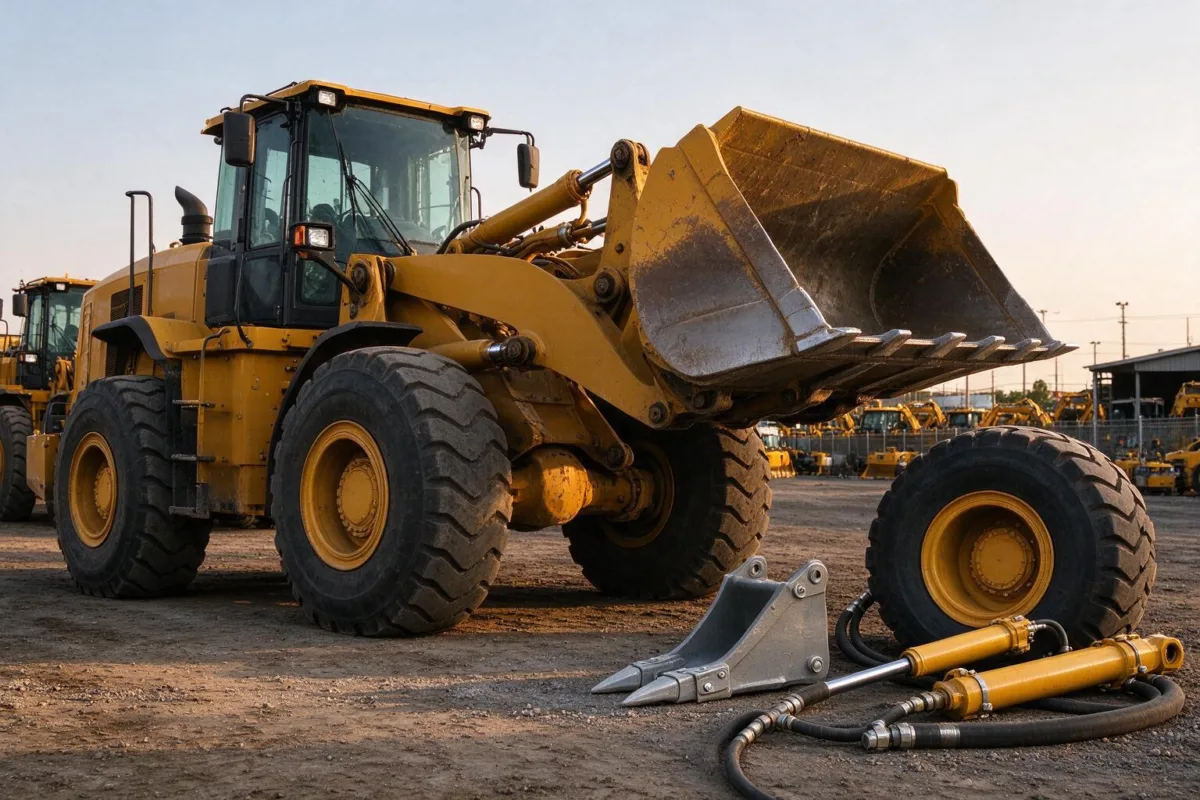
This XCMG loader parts buying guide begins with the model naming conventions that matter most for parts identification. XCMG wheel loaders are organized primarily into the LW series, with common designations including the LW300K, LW500K, and LW800K, alongside the older ZL series that remains in service in many fleets. The numeric portion of the model designation generally indicates rated load in hundreds of kilograms, so an LW500 corresponds to the 5-ton class and an LW300 to the 3-ton class. This convention is a useful starting point for parts identification but does not by itself confirm component fitment.
Key Component Groups and Wear Patterns
Loader parts fall into five functional groups, each with distinct wear characteristics that determine inspection intervals and replacement planning.
Driveline
The torque converter, transmission, drive shafts, and axles form the power path. In stockpile and rehandling work, frequent forward-reverse direction changes load the transmission clutch packs and torque converter seals heavily; these are among the highest-wear driveline items on machines such as the LW and ZL series. Oil analysis and clutch pack inspection intervals should shorten on machines cycling more than roughly 20 direction changes per hour.
Hydraulics
The main pump, valve block, lift and tilt cylinders, and hose assemblies carry the working circuit. Cylinder rod seals and chrome pitting on rod surfaces are common failure points in dusty or coastal environments, where abrasive ingress and salt air accelerate seal degradation and corrosion. Hose assemblies should be checked for abrasion at routing clamps.
Work Equipment
Bucket teeth, cutting edges, loader arms, and linkage pins take direct abrasive load. Pin and bushing wear accelerates with extended lubrication intervals and abrasive material, and worn pins transfer shock loads into the arms and bucket structure.
Undercarriage and Tires
Wheel loader tires wear unevenly depending on surface and load cycles. Tire size and ply rating must match the axle rating and application; an underspecified tire increases sidewall flex and heat buildup.
Electrical and Cab
Sensors, relays, harnesses, and HVAC components are vulnerable to corrosion and vibration, the primary causes of electrical faults. Connector sealing and harness routing checks belong in every service interval.
| Group | High-wear items | Primary causes |
|---|---|---|
| Driveline | Clutch packs, converter seals | Direction changes, heat |
| Hydraulics | Rod seals, chrome rods | Dust, salt air, abrasion |
| Work equipment | Teeth, edges, pins | Abrasive material, lubrication gaps |
| Tires | Tread, sidewalls | Surface, load cycles, rating mismatch |
| Electrical | Sensors, harnesses | Corrosion, vibration |
OEM, OES, and Aftermarket Parts: Definitions and Trade-offs
Loader parts for XCMG models such as the LW300, LW500, and ZL50 series reach the market through three distinct supply routes, each with different cost and traceability profiles.
OEM Parts
OEM parts are produced to the original equipment manufacturer’s specification and supplied through authorized channels. Each unit carries a verifiable part number tied to the machine’s serial range. This route offers the highest traceability and the highest cost. For buyers managing fleet compliance or warranty conditions, OEM documentation is the most defensible record.
OES Parts
OES (original equipment supplier) parts are manufactured by the same tier-one suppliers that produce for the OEM line, but may be sold under the supplier’s own brand rather than the machine brand. Quality is typically equivalent to OEM when the supplier identity and part number can be verified. The trade-off is administrative: the buyer must confirm the supplier relationship and cross-reference the number against the XCMG parts catalog before ordering.
Aftermarket Parts
Aftermarket parts vary widely in quality. Reputable suppliers publish material specifications, hardness ratings for pins and bucket teeth, and dimensional tolerances. Low-cost alternatives frequently omit this data, leaving buyers unable to assess fit or service life. In hydraulic and driveline components, small dimensional deviations compound quickly.
Safety-Critical Components
For brake valves, steering cylinders, and load-bearing pins, the cost difference between OEM and unverified aftermarket is rarely justified against downtime risk. A failed steering cylinder on a working face stops production and creates a safety exposure that outweighs the unit price saving.
| Category | Traceability | Typical Cost | Data Published |
|---|---|---|---|
| OEM | High, serial-linked | Highest | Full |
| OES | High if supplier verified | Moderate to high | Usually full |
| Reputable aftermarket | Moderate | Lower | Material and hardness data |
| Unverified aftermarket | Low | Lowest | Often none |
How to Verify Part Numbers and Supersessions
XCMG part numbers typically follow a structured format that encodes component group and variant. The leading digits identify the component group (for example, hydraulic pump, transmission, or wiring harness), while trailing characters denote the variant, revision, or market configuration. Because the same group code can carry multiple variants across production years, buyers should request the parts catalog page or exploded diagram for the specific serial number range of the machine. The serial number, not the model designation alone, determines which diagram applies.
Supersessions are common in XCMG loader parts. A part number may be replaced by a new number reflecting a revised material, a changed supplier, or an updated design. Before ordering, confirm whether the superseded part is backward-compatible with the existing installation or requires a mating component change, such as a different seal kit, bracket, or connector. A revised hydraulic pump, for instance, may use a different mounting flange or port thread.
Cross-reference aftermarket numbers against the OEM number using supplier catalogs rather than marketplace listings. Listings frequently map one aftermarket number to multiple OEM numbers incorrectly, and a single aftermarket number may cover several non-interchangeable variants.
For hydraulic and electrical parts, request the manufacturer name and country of origin. Generic labeling without traceable origin is a risk indicator, particularly for sensors, solenoids, and pump assemblies where tolerances and calibration affect performance.
| Verification Step | Document to Request |
|---|---|
| Confirm part number format and variant | Parts catalog page or exploded diagram for the serial number range |
| Check supersession compatibility | Supersession notice or service bulletin listing mating component changes |
| Validate aftermarket cross-reference | Supplier catalog, not marketplace listing |
| Confirm hydraulic/electrical origin | Manufacturer name and country of origin on the label |
Supplier Evaluation Checklist
A structured evaluation reduces the risk of fitting incorrect or unverified components to XCMG wheel loaders, including the LW300, LW500, ZL50, and larger 6-tonne class machines.
Documentation and identification
The supplier should confirm in writing the part number, the applicable serial number range, and the material or dimensional specification for the item. XCMG part numbers can change across production runs, and a number that fits an early LW500FN may not fit a later build. Written confirmation creates a record for warranty claims and returns.
Component traceability
For critical items such as hydraulic pumps, brake valves, and transmission control valves, ask for the manufacturer’s name. Distributors unable to name the producer of these components are typically reselling without technical control over the supply chain, which complicates fault diagnosis and replacement matching.
Warranty and returns
Check warranty duration, whether consequential damage is covered, and the process for returning incorrectly supplied parts. Terms should be in writing, with the return window and restocking policy stated explicitly.
Export documentation
If the loader operates outside the supplier’s primary market, verify the capability to issue correct HS codes, certificates of origin, and packing lists. Misclassified HS codes and missing origin certificates are common causes of customs delays.
Lead times
Request lead times for both stock and non-stock items. For a loader in production use, downtime cost frequently exceeds the price difference between suppliers.
| Check | Evidence required |
|---|---|
| Part number and serial range | Written confirmation |
| Critical component origin | Manufacturer name |
| Warranty terms | Written policy |
| Export documents | HS code and certificate of origin samples |
| Lead time | Stock and non-stock estimates |
Counterfeit and Low-Quality Parts: Recognition Points
Counterfeit XCMG loader parts are most reliably identified at the point of receipt, before installation. Inspection should cover packaging, castings and forgings, seals and hoses, and electrical components.
Packaging
Counterfeit packaging commonly shows inconsistent fonts across labels, missing batch codes, and no manufacturer address. Genuine packaging carries traceable batch and date information that can be cross-referenced against the supplier’s documentation. Cartons for items such as the ZL50G or LW500 series should be checked for label alignment, print quality, and legibility of the part number.
Castings and Forgings
Porosity, uneven machining marks, and missing heat-treatment codes indicate uncontrolled production. Pins and bucket teeth should show consistent hardness across the batch; spot checks with a portable hardness tester on a sample of pins and teeth will reveal variation typical of unverified stock. Lift arm and bucket pivot pins for 5-ton class loaders are frequently counterfeited and warrant particular attention.
Seals and Hoses
Counterfeit hydraulic seals often use incorrect elastomer compounds that fail prematurely at operating temperature. Seal lips should be uniform, with no flash or dimensional variance at the lip contact area. Hose assemblies should carry a pressure rating and date of manufacture; assemblies lacking either marking should be rejected.
Electrical Components
Sensors and relays without manufacturer markings, or with mismatched connector keying, should be rejected. Connector keying that does not match the harness on the machine indicates either a counterfeit or an incorrect part number.
| Component | Key Check |
|---|---|
| Packaging | Batch code, date code, manufacturer address |
| Castings/forgings | Porosity, machining marks, heat-treatment code |
| Seals/hoses | Elastomer quality, pressure rating, date code |
| Electrical | Manufacturer marking, connector keying |
Maintenance Planning and Stock Recommendations
Stock levels should reflect the duty cycle of each machine rather than a single fleet-wide rule. Loaders in continuous stockpile or quarry work typically consume bucket teeth, cutting edges, pins, bushings, and hydraulic hoses at a substantially higher rate than loaders in intermittent construction use. A machine running two or three shifts in abrasive material may need several times the on-hand inventory of the same model working occasional site duty. Fleet managers can use historical consumption per 1,000 operating hours to set reorder points for each duty class.
Wear rates should be tracked by component and by operating hours, not by calendar interval alone. Pins and bushings should be replaced as sets; fitting a new pin into a worn bushing, or the reverse, produces mismatched clearances that accelerate wear on both parts and on the surrounding linkage. Recording hours at each replacement builds a wear curve that supports planned downtime instead of unplanned failure.
Machines with electronic control systems warrant a stock of critical sensors and relays. A single failed sensor can immobilize the loader, and lead time on a specific part number may exceed the tolerance for downtime. Hydraulic oil analysis at regular intervals provides early indication of pump and valve condition through contamination and temperature trends, allowing intervention before a failure occurs.
A parts record linked to machine serial number and documented supersessions ensures that future orders reference the correct current part number.
| Duty class | Higher-turn stock items |
|---|---|
| Continuous stockpile or quarry | Bucket teeth, cutting edges, pins, bushings, hydraulic hoses |
| Intermittent construction | Wear parts at lower depth, filters, critical sensors |
Application-Specific Parts Considerations
Loader duty cycles vary widely, and parts selection should follow the machine’s actual working environment rather than a single generic specification.
Earthmoving and Excavation
Machines working in abrasive soil, rock, and gravel should prioritize undercarriage components and bucket wear parts with high abrasion resistance. Cutting edges and teeth should match material density: thicker, through-hardened edges suit dense, rocky material, while standard edges are adequate for loose soil. Track chains, rollers, and idlers on crawler loaders, or tire and rim protection on wheeled units, warrant closer inspection intervals in these conditions.
Material Handling and Agriculture
In stockyard, yard, and agricultural work, hydraulic system cleanliness and tire type matter more than extreme wear resistance. Contamination control, correct filtration, and clean fluid handling protect cylinders and valves. Wide-base tires reduce ground pressure and surface damage, and smooth or bolt-on bucket edges minimize damage to yards, feedlots, and paved surfaces.
Waste and Recycling
Waste and recycling applications demand reinforced buckets, puncture-resistant tires, and sealed electrical connectors to withstand debris, wire, and contamination. Guards and seals around harnesses and sensors reduce failure from exposure to refuse and wash-down.
Cold Climate
Cold-climate operation requires engine block heaters, cold-start electrical components, and low-temperature hydraulic seals specified at order time. Standard parts may not perform below their rated temperature, so seal material and heater specifications should be confirmed against the expected ambient range before purchase.
| Application | Priority Parts | Key Specification |
|---|---|---|
| Earthmoving | Undercarriage, bucket edges, teeth | High abrasion resistance, density-matched edges |
| Material handling/agriculture | Hydraulics, tires | Cleanliness, wide-base tires, smooth edges |
| Waste/recycling | Buckets, tires, connectors | Reinforcement, puncture resistance, sealing |
| Cold climate | Heaters, electrical, seals | Low-temperature rating at order time |