
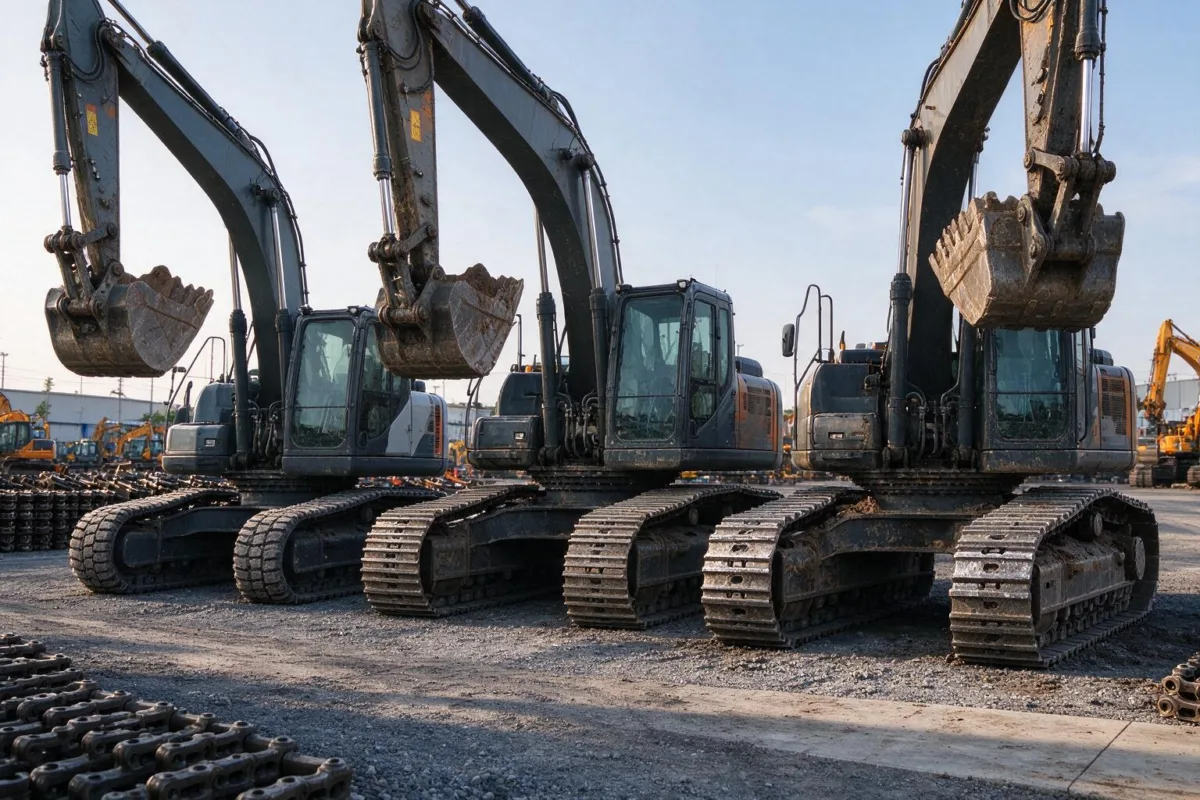
Liugong excavators are organized into compact, medium, and large series, and this Liugong excavator undercarriage selection guide treats operating weight class, not model name alone, as the primary reference for choosing replacement components. Two machines with similar model numbers can carry different track group specifications if their operating weights differ, so weight class should be confirmed before any part is ordered. Undercarriage sizing follows the same logic across the range, from compact units through large frames, because track chain pitch, roller dimensions, and shoe width are matched to the loads the machine actually carries rather than to its badge.
Track Chain and Shoe Plate Selection
Track pitch is the first specification to confirm. The chain pitch must match the drive sprocket tooth count and the original chain specification for the machine. Fitting a chain of a different pitch alters the meshing geometry between bushing and sprocket tooth, which accelerates wear on both components and shortens the service interval of the entire track group. Pitch is normally verified against the undercarriage section of the machine’s parts listing rather than measured from a worn chain, since stretched links can give a misleading reading.
Lubricated track chains are standard on medium and large Liugong excavators, where sustained load and long daily hours justify the higher initial cost. Sealed chains appear on some compact models and lighter applications, where duty cycles are shorter and the lubrication reservoir offers less benefit relative to price.
Shoe width follows ground bearing pressure. Narrow triple-grouser shoes suit firm, rocky ground where traction and penetration matter more than flotation. Wider shoes are specified for soft or wet soil where the machine must spread its weight and avoid sinking. Shoe plate thickness and grouser height are wear items; measuring grouser height against the original specification gives a practical indication of remaining service life before shoe replacement is due.
Track group assemblies are commonly supplied as matched sets of chain, shoes, and hardware. Installing matched sets on both sides helps maintain even wear and keeps the machine tracking straight.
Bottom and Carrier Roller Specifications
Bottom rollers on Liugong excavators are classified by flange type: single-flange, double-flange, and center-flange designs. The correct configuration depends on the roller’s position along the track frame and the chain guidance requirements at that location. Double-flange rollers are commonly used where lateral chain guidance is needed, while single-flange and center-flange rollers are applied at positions where the track frame geometry limits flange clearance. Installing the wrong flange type at a given position can cause flange-to-link contact and accelerated wear.
Roller shell diameter, flange height, and shaft diameter must match the machine’s original specification. Dimensional mismatch causes misalignment with the track chain, leading to uneven link and bushing wear, increased rolling resistance, and premature seal failure. Specifications should be verified against the parts listing for the specific model series rather than by visual comparison alone.
Carrier (top) rollers support the upper run of the chain. On Liugong models they are typically single- or double-flange depending on track frame design. Sealed roller assemblies with lifetime-lubricated bearings are standard for most medium and large models. During routine maintenance, inspect for seal leakage, lubricant loss, and shell wear, and check flange contact on the chain links.
| Roller Type | Flange Configuration | Primary Function |
|---|---|---|
| Bottom roller | Single-flange | Chain support with one-sided guidance |
| Bottom roller | Double-flange | Chain support with two-sided guidance |
| Bottom roller | Center-flange | Chain support where frame geometry requires central guidance |
| Carrier roller | Single- or double-flange | Support of the upper chain run |
Roller replacement is generally recommended in complete sets per side. Replacing individual rollers against worn components produces uneven chain loading and shortens the service life of both new and remaining parts.
Idler and Sprocket Matching
The front idler on a Liugong excavator must match both the track frame guide and the chain pitch. The idler guides the chain into the drive sprocket and maintains alignment along the track frame. Rim diameter and flange profile directly affect chain tracking; an incorrect flange height or worn flange allows the chain to climb the rim, which accelerates guide wear and can cause derailment under load. Idler part numbers should be cross-checked against the specific model series (for example, 922E, 933E, or 950E) and the chain pitch fitted to that machine.
Sprockets are matched to chain pitch and tooth count. A worn sprocket paired with a new chain causes rapid bushing wear because the tooth valleys no longer seat the bushings correctly, and the two components should be replaced together. Mixing a new chain with a worn sprocket, or the reverse, shortens the service life of both.
Idler assemblies are supplied in different configurations. Complete assemblies include the shaft, bearings, and seals; rim-only components exclude the hub and bearing group. Confirm which configuration is required before ordering, since installation and downtime differ substantially.
Track tension adjustment through the recoil spring and grease cylinder should be checked whenever idlers or chains are replaced. Incorrect tension affects both idler bearing load and chain wear.
| Inspection item | Recorded value | Action threshold |
|---|---|---|
| Sprocket tooth wear | Measured tooth profile | Replace with chain |
| Idler flange wear | Flange height and profile | Replace rim or assembly |
Sprocket tooth wear and idler flange wear should be recorded at each inspection interval so replacement can be planned before chain damage occurs.
Matching Undercarriage to Application and Ground Conditions
Undercarriage specification for Liugong excavators should follow the duty cycle and ground conditions the machine will actually face. The standard track group fitted to models such as the 900-series and 200-series excavators is intended for general construction and earthmoving, where loads are moderate and abrasive wear is limited. Quarry, demolition, and abrasive rock work call for reinforced or heavy-duty track groups, which use thicker link sections, larger-diameter pins, and heavier bushings to resist impact and wear.
High-abrasion conditions such as sand and gravel accelerate wear on bushings and roller seals. In these applications, reinforced chains and sealed rollers reduce the rate of internal pin and bushing wear and protect lubricant retention. Soft, wet ground presents a different problem: wider shoe plates are used to lower ground pressure, and specification should focus on bearing pressure limits rather than component strength. Excessively wide shoes on firm ground can increase link and pin loading, so shoe width should match the actual soil condition.
Long-distance travel and frequent repositioning place higher loads on idlers and carrier rollers. Machines used in this pattern should be specified with idlers and carrier rollers rated for continuous travel duty. Operation in mud and water raises the importance of seal quality in rollers, idlers, and the track tensioner, and it makes regular track tension checks essential to prevent derailment and accelerated pin wear.
| Condition | Undercarriage consideration |
|---|---|
| General construction | Standard track group |
| Quarry, demolition, abrasive rock | Reinforced or heavy-duty group |
| Sand and gravel | Reinforced chains, sealed rollers |
| Soft, wet ground | Wider shoe plates, bearing pressure limits |
| Frequent travel | Higher-rated idlers and carrier rollers |
| Mud and water | Seal quality, routine tension checks |
Wear Assessment and Replacement Timing
Undercarriage wear on Liugong excavators is progressive and predictable when measured at defined intervals. Track chain condition is tracked through three primary measurements: pitch elongation, bushing diameter, and grouser height. Pitch elongation is measured across a defined number of links and compared against the wear limit published for the specific chain size; the same applies to bushing outside diameter and grouser height. Intervals should be set according to application severity, with shorter cycles in abrasive or high-impact conditions.
Roller shell wear is measured at the tread. Diameter reduction beyond the specified limit compromises chain support, increases link articulation loads, and accelerates wear on adjacent components, so rollers at or past the limit should be replaced.
Sprocket wear is assessed at the tooth root and flank. As the tooth profile wears, the chain sits lower in the gullet, and pronounced hooking indicates the sprocket can no longer maintain correct chain engagement. At that point, replacement is due.
Uneven wear between the left and right track groups is a common diagnostic finding. It typically points to turning patterns, ground conditions, or track tension imbalance rather than a component defect. Tension should be checked and corrected before attributing the difference to the undercarriage itself.
| Component | Measurement point | Replacement trigger |
|---|---|---|
| Track chain | Pitch elongation, bushing diameter, grouser height | Exceeds published wear limit |
| Roller | Shell diameter at tread | Diameter reduction beyond limit |
| Sprocket | Tooth root and flank | Significant tooth hooking |
Replacing a single worn component on an otherwise worn track group often shortens the life of the new part, because the remaining worn components impose abnormal loads on it. Matched replacement of the full group is generally more economical across the complete wear cycle.
Identifying Genuine and Aftermarket Undercarriage Parts
Part number verification is the first control point. Liugong assigns undercarriage part numbers by model and serial range, and the same nominal component can differ across production breaks. Buyers should check the number on the part or label against the Liugong parts catalog for the specific machine model and serial number, not against a generic model listing. Packaging and casting marks should be consistent, legible, and free of overstamping or mismatched fonts.
Genuine and reputable aftermarket suppliers provide material specifications, hardness values, and dimensional drawings. The absence of these documents is a warning sign, particularly for track groups, rollers, and idlers where steel grade and heat treatment determine service life. Appearance alone is unreliable. Roller shell thickness, flange dimensions, and seal type should be measured and compared against the original part.
Heat treatment indicators and surface finish also warrant inspection. Hardness readings that vary across the tread of a roller or the link rail suggest inadequate quality control. A reputable supplier can document hardness testing results and confirm the seal design, whether a standard lip seal or a more durable floating seal arrangement.
Traceability and warranty terms should be verified before ordering. For high-value track group orders, buyers should request dimensional inspection reports covering link pitch, bushing outer diameter, roller diameter, and mounting dimensions. Suppliers who decline to provide this documentation should be treated with caution.
| Check | What to Verify |
|---|---|
| Part number | Matches catalog for model and serial range |
| Documentation | Material spec, hardness values, dimensional drawing |
| Dimensions | Shell thickness, flange size, seal type vs. original |
| Heat treatment | Consistent hardness across tread |
| Traceability | Supplier records and warranty terms |
Procurement Checklist for Liugong Undercarriage
Undercarriage parts for Liugong excavators are frequently ordered against incomplete machine data, which leads to mismatched components and avoidable downtime. The following checklist outlines the information that should be confirmed before a quotation is requested.
Machine and Configuration Data
Confirm the model and serial number, including any regional build variant, since undercarriage specifications can change across production runs. Obtain the undercarriage configuration code where the machine record provides one; this code typically resolves ambiguity between track frame widths, roller counts, and shoe options. Serial number ranges should be cross-checked against the parts listing rather than assumed from the model designation alone.
Component Specifications
Each line item should state chain pitch, link count, shoe width and type (triple-grouser, double-grouser, or rubber), roller flange configuration (single or double flange, and position on the frame), and sprocket tooth count. For idlers and track adjusters, note the assembly type and any seal or bushing details. Vague descriptions such as “standard track group” are insufficient for verification.
Matched Sets and Supply Format
Where wear pairing affects service life, particularly chain and sprocket combinations, request matched sets rather than individual components. Clarify whether each item is a complete assembly or component-only supply, and confirm whether mounting hardware, seals, and lubricant fittings are included.
Inspection and Warranty Terms
Agree in writing on inspection criteria, dimensional tolerances, and warranty coverage before order confirmation. This should include hardness or material verification where applicable and the process for documenting non-conforming parts on receipt.
| Item | Required Detail |
|---|---|
| Machine data | Model, serial number, configuration code |
| Track chain | Pitch, link count, matched-set status |
| Shoes | Width, type, bolt pattern |
| Rollers | Flange configuration, position |
| Sprocket | Tooth count, pairing with chain |
| Supply format | Assembly or component, hardware and seals |
| Terms | Inspection criteria, tolerances, warranty |