
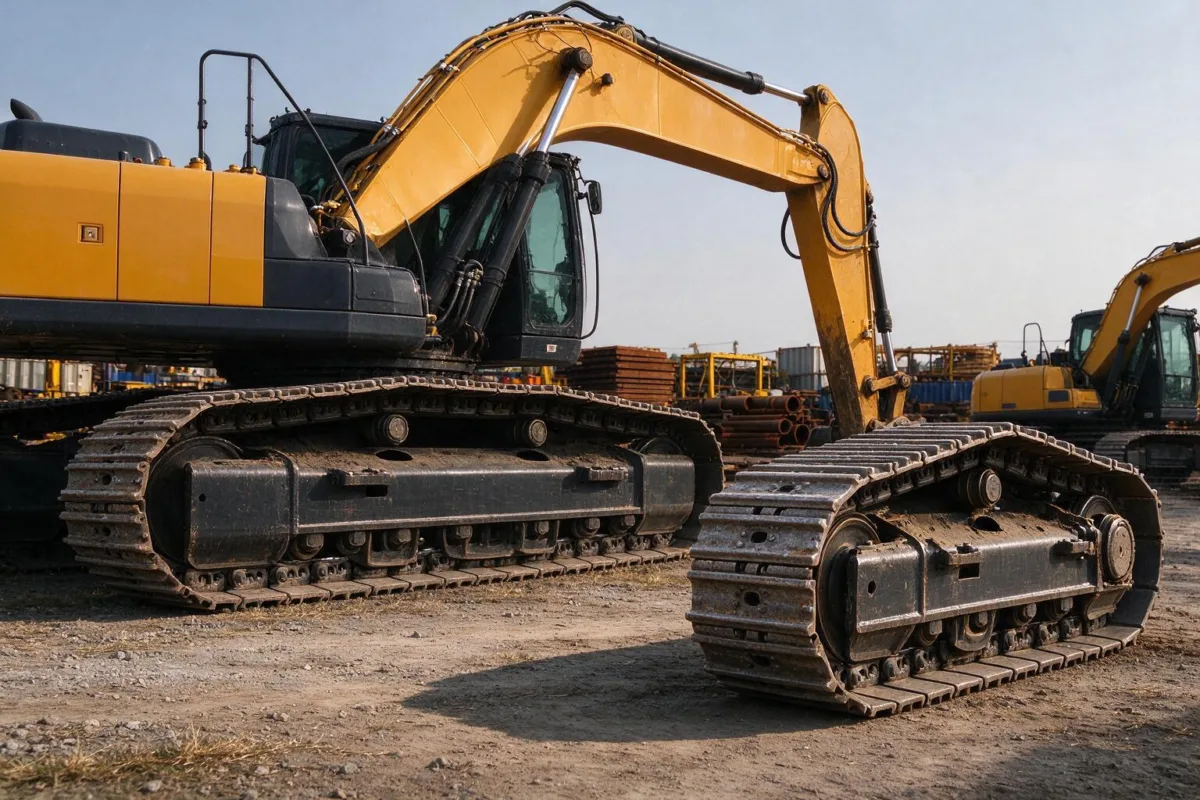
This XCMG excavator undercarriage selection guide addresses undercarriage selection for XCMG hydraulic excavators, covering the principal wear components: track chains, track shoes, rollers (carrier and track), idlers, sprockets, and track frames. It is intended for fleet managers, maintenance planners, and parts buyers who source replacement undercarriage components for XCMG units and who need a structured basis for matching components to machine and job conditions.
Undercarriage selection depends on three primary inputs: machine tonnage class, application duty cycle, and underfoot conditions. Brand name alone does not determine the correct specification. A 20-tonne class machine working in abrasive quarry material imposes different demands on track chain and shoe selection than the same class working in soft, muddy ground or on paved surfaces. Duty cycle—continuous production, intermittent utility work, or attachment-heavy operation such as breaker use—affects roller and idler bearing life as much as it affects chain wear rates. Ground conditions govern shoe width and grouser height, and they influence whether sealed or lubricated chain options are justified by the wear environment.
XCMG Excavator Series Relevant to Undercarriage Selection
The XCMG XE series spans mini through large hydraulic excavators, and undercarriage sizing scales directly with operating weight class. Track gauge, shoe width, roller count, and chain pitch are all matched to the machine’s weight and duty rating, so undercarriage selection should begin with the model’s operating weight rather than with a generic size category.
Compact classes, roughly 1.5 to 8 t, typically use rubber track groups or short-pitch steel track groups with single- or double-flange rollers. Rubber tracks suit paved and finished-surface work, while steel short-pitch groups are preferred where abrasion and load are higher.
Mid-size classes, roughly 13 to 30 t, use standard sealed or lubricated track chains with segmented or full-length track shoes. Shoe selection here is commonly driven by ground conditions: triple-bar or grouser shoes for general earthmoving, flat or rubber-pad shoes for surface-sensitive work.
Large classes, roughly 35 t and above, use heavy-duty sealed and lubricated track (SLT) chains, larger-diameter bushings, and reinforced track frames. These components are sized to absorb higher drawbar pull and repeated impact loading in quarry and demolition applications.
XE series machines are widely deployed in earthmoving, trenching, quarry, and demolition work, and each duty cycle changes undercarriage wear rates materially. Trenching concentrates wear on shoe edges, quarry work accelerates bushing and roller wear through abrasion, and demolition adds impact loading to track frames and links.
| Weight Class | Typical Range | Track Group | Roller Type | Shoe / Chain Notes |
|---|---|---|---|---|
| Compact | 1.5–8 t | Rubber or short-pitch steel | Single- or double-flange | Short-pitch chain, narrow shoes |
| Mid-size | 13–30 t | Sealed or lubricated | Standard flange | Segmented or full-length shoes |
| Large | 35 t and above | Heavy-duty SLT | Heavy-duty flange | Larger bushings, reinforced frames |
Undercarriage Components and Their Selection Variables
Undercarriage selection for XCMG excavators is governed by the interaction between individual components, machine class, and operating conditions. Each component carries variables that must be matched to the surrounding assembly rather than specified in isolation.
Track Chain
Chain pitch, link count, bushing diameter, and seal type (sealed, lubricated, or dry) must match the carrier roller and sprocket configuration. Pitch determines sprocket engagement geometry, while link count defines the chain loop length for a given model series. Bushing diameter affects wear life and load distribution, and the seal type governs lubrication retention and service interval.
Track Shoes
Shoe width, thickness, grouser height, and bolt pattern are selected against ground bearing pressure and traction requirements. Wider shoes reduce bearing pressure on soft ground; taller grousers improve grip in loose or muddy conditions. Bolt pattern must align with the chain link spacing.
Track Rollers
Single- or double-flange design, flange diameter, and shell hardness determine load capacity and side-load resistance. Double-flange rollers are common on larger classes where lateral forces are higher.
Carrier Rollers
Upper roller count and mounting position vary by model and affect track sag control. Correct placement maintains chain tension across the top run.
Idlers
Front idler diameter and recoil spring rating must suit the track tension range of the machine class. An undersized spring cannot absorb shock loads or maintain tension.
Sprockets
Tooth count and pitch must match the chain. Sprocket wear accelerates chain stretch if left unmanaged, so sprockets should be inspected alongside chain condition.
| Component | Primary Selection Variables |
|---|---|
| Track chain | Pitch, link count, bushing diameter, seal type |
| Track shoes | Width, thickness, grouser height, bolt pattern |
| Track rollers | Flange type, flange diameter, shell hardness |
| Carrier rollers | Roller count, mounting position |
| Idlers | Diameter, recoil spring rating |
| Sprockets | Tooth count, pitch |
Matching Undercarriage to Ground Conditions
Undercarriage specification on XCMG excavators should follow the dominant ground condition at the jobsite, not a single default configuration. Shoe width, grouser height, plate thickness, and chain and roller ratings each trade off differently across surfaces.
On firm, dry ground, standard-width shoes with moderate grouser height limit rolling resistance and reduce chain load. Narrower shoes penetrate hard surfaces less and keep travel effort low, which matters on the compact and medium series where travel motor torque is sized to standard widths.
On soft or muddy ground, wider shoes lower ground bearing pressure but increase bending load on links and pins. The wider the shoe, the greater the lever arm applied to the chain assembly during turns and side loading, so link and pin wear accelerates even as flotation improves.
On rocky or abrasive ground, thicker shoe plates, hardened grousers, and reinforced bushings extend service life. Abrasion between pin and bushing is the primary wear mode in these conditions, and hardened components slow the wear rate more effectively than any change in shoe width.
Slope work favors wider shoes with higher grousers for traction and side-load behavior, balanced against increased wear on rollers and idlers. Side loads on slopes concentrate on roller flanges and idler faces, and the same width that improves grip raises that loading.
Demolition and recycling involve frequent turning and impact loading, which favor heavy-duty chains and reinforced roller flanges. Long travel distances between work areas increase bushing and sprocket wear independent of digging duty, so machines that road frequently should be specified with wear-resistant chain components regardless of the digging application.
| Ground condition | Shoe and component emphasis | Primary wear effect |
|---|---|---|
| Firm, dry | Standard width, moderate grouser | Low rolling resistance, reduced chain load |
| Soft or muddy | Wider shoes | Higher link and pin bending load |
| Rocky or abrasive | Thicker plates, hardened grousers, reinforced bushings | Slower pin and bushing abrasion |
| Slope work | Wider shoes, higher grousers | Increased roller and idler wear |
| Demolition and recycling | Heavy-duty chain, reinforced roller flanges | Impact and turning load resistance |
Sealed, Lubricated, and Dry Chain Options
Track chain selection for XCMG excavators comes down to three construction types: dry, sealed, and lubricated. Each trades cost against service life and maintenance demand, and the correct choice depends on the machine class, working environment, and duty cycle.
Dry Chains
Dry chains run without grease in the pin-bushing joint. They cost less and suit low-hour machines, rental fleets, or budget-sensitive applications where the undercarriage is not expected to reach high hour totals. The absence of internal lubrication means the pin and bushing interface wears faster in abrasive conditions, so these chains require more frequent inspection of pin diameter, bushing wear, and joint play. External lubrication of the joint is not a substitute for a sealed design.
Sealed Chains
Sealed chains retain grease in the pin-bushing joint using seals at each link. This limits internal wear in dusty, muddy, or high-abrasion conditions where grit would otherwise enter the joint. Sealed chains are common on compact and mid-size XCMG units operating in mixed ground and are typically the baseline choice for general construction work.
Lubricated (SLT) Chains
Lubricated chains, often designated SLT, use a grease reservoir in the pin that feeds the bushing over time. They are common on mid-size and larger XCMG excavators, particularly in high-hour applications, because the reservoir extends service intervals and reduces internal wear compared with dry chains.
Matching and Ordering
| Chain type | Internal lubrication | Typical application |
|---|---|---|
| Dry | None | Low-hour, budget-sensitive |
| Sealed | Grease retained by seals | Dusty, abrasive ground |
| Lubricated (SLT) | Pin reservoir | Mid-size and larger, high-hour |
Chain type must match the sprocket and roller set. Mixing types within one undercarriage produces uneven pitch growth and accelerates wear across the assembly. Replacement chains should be ordered by pitch, link count, and bushing diameter, not by model name alone, since the same model series can carry different undercarriage configurations.
Wear Indicators and Replacement Timing
Undercarriage wear on XCMG excavators progresses as a system, and inspecting each component against the manufacturer’s wear limits allows replacement to be planned before related parts are damaged.
Track Chain
Bushing external diameter and track pitch elongation are the primary chain wear indicators. Pitch is measured across several links with the chain under tension; elongation beyond the manufacturer’s limit indicates internal pin and bushing wear that cannot be corrected by adjustment.
Sprocket
Tooth root and tooth flank wear are measured with a sprocket gauge or profile template. A worn sprocket has a changed pitch line and rapidly damages a new chain, so sprocket condition should be assessed whenever chain replacement is considered.
Track Rollers and Idlers
Inspection covers flange height, shell diameter, and seal condition. Oil leakage at the seals or excessive axial and radial play indicates bearing wear. Rollers worn below the flange limit allow the chain to drift and increase link and bushing loading.
Track Shoes
Grouser height and plate thickness are measured at several points per shoe. Worn grousers reduce traction and increase slip, which raises chain load and accelerates wear elsewhere in the undercarriage.
Track Tension
Sag is checked against the model-specific specification for the XE series and adjusted by grease volume in the recoil cylinder. Excessive sag accelerates sprocket and idler wear and promotes link-tooth misalignment.
Where wear is advanced, chain and sprocket should be replaced as a set. A new chain running on a worn sprocket seats poorly and fails prematurely.
Verifying Fitment and Part Identification
Undercarriage fitment errors on XCMG excavators typically originate at the identification stage rather than the installation stage. Buyers should begin by recording the machine model, serial number, and undercarriage configuration directly from the machine plate, then cross-reference these details against the XCMG parts catalog for the specific production range. Serial number breaks matter: XCMG has revised track group and roller specifications across series such as the XE215 and XE370 without changing the model designation, so a catalog entry keyed only to model name is insufficient.
Physical verification of the original component is the next step. Key dimensions include:
- Pitch and link count for the track chain
- Shoe width and bolt hole spacing (gauge and count per link)
- Roller flange type (single, double, or center-flanged) and mounting hole pattern
- Bushing and pin diameter where the chain is being matched to existing sprockets
Aftermarket suppliers should state material hardness and heat treatment for links, pins, and bushings, for example HRC ranges for pin surfaces and specified induction hardening or carburizing processes. A supplier that omits these specifications cannot be assessed against the original part.
For large-class undercarriage components, buyers should request dimensional drawings or measurement sheets before placing an order. These documents allow comparison against the removed part and reduce the risk of freight-costly returns.
Finally, confirm warranty terms, lead time, and packing method. Track groups, idlers, and rollers are heavy and vulnerable to handling damage; crated or palletized packing with edge protection is preferable to loose bundling, and warranty terms should be reviewed for coverage of seal failures and premature wear.
Cost and Lifecycle Considerations
Undercarriage components typically account for a substantial share of total excavator maintenance cost over the machine’s service life, often cited in the range of 20 to 30 percent depending on application. Because of this weighting, selection decisions should be evaluated on cost per operating hour rather than unit purchase price. A lower-priced chain that reaches end of life earlier can cost more per hour than a higher-grade assembly with a longer wear cycle, particularly when labor and downtime are included.
Matched component sets generally deliver longer combined service life than mixed-wear assemblies. When chain, sprocket, rollers, and idlers are replaced as a set, the pitch and wear relationships between components remain within design tolerances. Installing a new chain on a worn sprocket, or new rollers under a stretched chain, accelerates wear on the newer parts and shortens the effective life of the whole system.
Service life is also governed by factors outside component grade. Application severity, operator practice, and track tension maintenance influence wear rates as much as material specification. Operation in abrasive or rocky ground, frequent turning on hard surfaces, and sustained over- or under-tensioning all reduce achievable hours.
Keeping wear records by position allows rotation of components and planned replacement, which reduces unplanned downtime. Measuring bushing diameter, link height, roller flange wear, and sprocket tooth profile at intervals gives a basis for forecasting replacement before failure occurs.
When evaluating aftermarket undercarriage options, buyers should compare quoted specifications rather than model labels. Relevant data include link pitch, bushing and pin diameter, roller shell thickness, and material hardness.
| Comparison point | Specification to request |
|---|---|
| Track chain | Link pitch, bushing/pin diameter, hardness |
| Sprocket | Tooth count, pitch match, hardness |
| Rollers and idlers | Shell thickness, flange dimensions, seal type |