
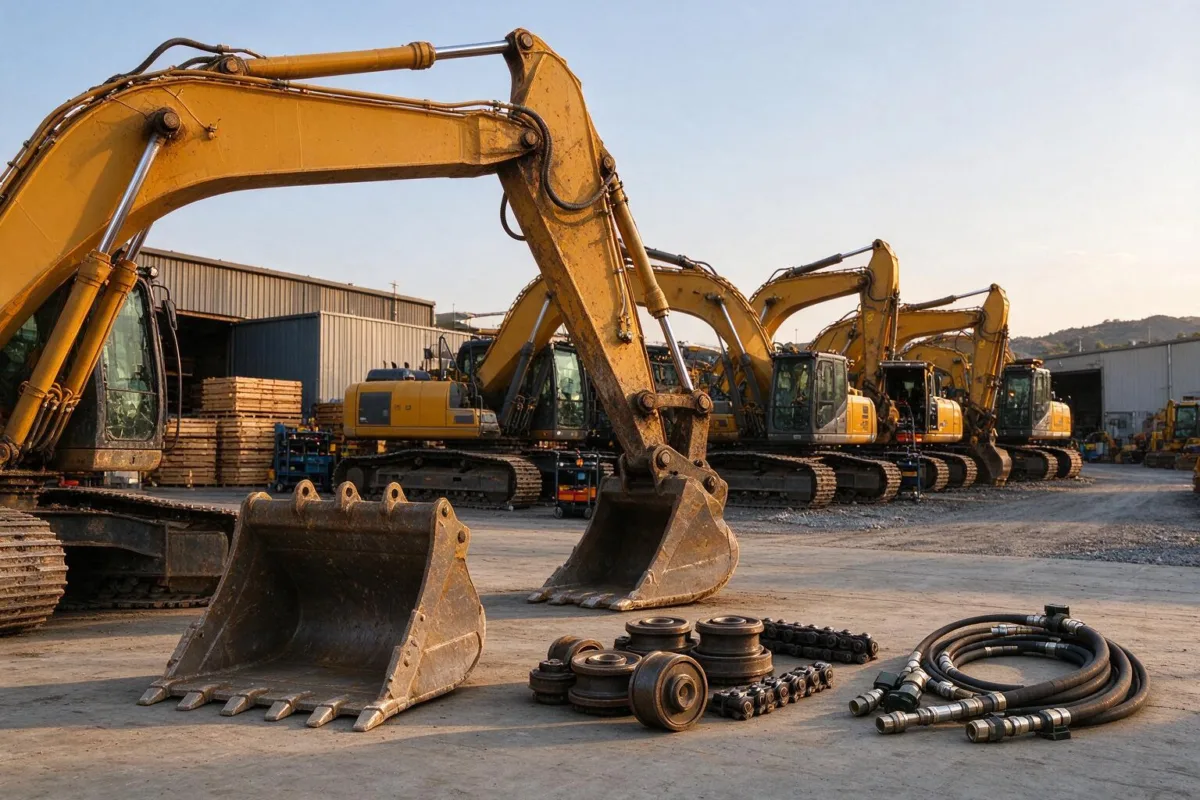
This Liugong excavator parts buying guide starts with the series, because parts compatibility on these machines follows the model code and generation rather than the brand name alone. Liugong excavators span compact, medium, and large classes, and codes such as CLG9035E, CLG922E, CLG936E, and CLG950E indicate both tonnage class and generation. A part listed for a nominal 20-ton class machine may not fit a specific E-series or F-series unit, because the same displacement class can carry different hydraulic layouts across generations. Pump mounting, valve block configuration, and hose routing can change even where the nominal tonnage stays constant.
Liugong Excavator Model Series and Typical Component Families
Liugong’s excavator range spans compact, medium, and large classes, and the parts profile of each class differs enough that model identification should precede any component order.
Compact Class (1.5 to 8 tons)
Compact models are commonly used in utility, landscaping, and rental work. These machines share smaller final drives, pilot valves, and compact hydraulic pumps. Because several models in this class draw on common component families, cross-referencing the exact model and serial number remains necessary, but the parts pool is comparatively narrow.
Medium Class (13 to 26 tons)
Medium models dominate general construction. They typically use variable-displacement main pumps, multi-way valves, and travel motor assemblies with integrated brakes. Hydraulic and undercarriage parts for this class are the most frequently traded, and aftermarket availability is broadest here.
Large Class (above 30 tons)
Large models serve quarry and bulk earthmoving applications. They carry heavier undercarriage components, larger swing drives, and higher-flow hydraulic systems. Component weights and flow ratings differ substantially from medium-class parts, so interchange across classes is not practical.
Wheeled Variants
Wheeled excavator variants use different axle and transmission components than tracked units. These parts should not be sourced against tracked model catalogs, even where the upper structure is similar.
Attachment Configuration
Attachment configuration affects parts selection. A machine fitted with a breaker or shear circuit may use additional auxiliary valve sections and different hose routing. When ordering hydraulic or hose components, confirm the auxiliary circuit layout rather than assuming a standard configuration.
| Class | Typical tonnage | Representative component families |
|---|---|---|
| Compact | 1.5–8 t | Small final drives, pilot valves, compact pumps |
| Medium | 13–26 t | Variable-displacement main pumps, multi-way valves, travel motors with integrated brakes |
| Large | above 30 t | Heavy undercarriage, large swing drives, high-flow hydraulics |
| Wheeled | varies | Axles and transmissions distinct from tracked units |
High-Wear Components and Inspection Points Before Replacement
Wear-related replacement decisions on Liugong excavators should be based on measured values compared against service limits, not on visual impression. The following inspection points apply across the 900-series and F-series ranges, including the 920, 922, 925, 933, 936, and 950 models.
Undercarriage
Track link height, bushing outer diameter, sprocket tooth profile, and roller flange thickness all have published wear limits. Measure track link height at the pin boss, bushing wear at the most worn point of the outer diameter, and sprocket tooth thickness at the root. Roller flange thickness is checked with a caliper at the flange edge. A component that looks serviceable may already be past its limit, and a worn sprocket accelerates chain wear on new links.
Hydraulic Cylinders
Inspect the rod chrome for scoring and pitting along the full stroke, check seal groove condition in the gland and piston, and verify rod straightness with a dial indicator. A leaking seal on a scored rod will fail again after replacement; the rod must be repaired or replaced first.
Pumps and Motors
Pressure and flow testing before removal prevents replacement of a serviceable unit. Contamination-related wear typically affects the entire circuit, so a failed pump usually indicates flushing and filter review rather than a single-component swap.
Pins and Bushings
Measure clearance at the bucket linkage and boom foot. Excess clearance there accelerates cylinder rod and seal damage through misalignment.
Electrical and Sensor Components
Read fault codes before replacing sensors. Harness and connector faults frequently mimic sensor failure.
| Component | Measurement | Reference |
|---|---|---|
| Track link | Link height | Service limit |
| Bushing | Outer diameter | Service limit |
| Sprocket | Tooth thickness | Service limit |
| Roller | Flange thickness | Service limit |
| Bucket linkage | Pin-to-bushing clearance | Service limit |
OEM, OES, and Aftermarket Parts: What the Categories Mean
OEM parts are produced to the machine maker’s specification, though not necessarily by the machine maker. Many OEM components are built by specialist suppliers and branded for the excavator manufacturer. The defining factor is the specification, not the production site.
OES parts are supplied through the original channel with original packaging. They meet the same specification as OEM parts and are typically stocked through dealer networks. The distinction between OEM and OES is largely one of distribution route.
Aftermarket parts vary widely. Reputable aftermarket suppliers publish material grades, hardness specifications, and dimensional tolerances; unbranded parts rarely do. Buyers should treat missing data as a signal, not an inconvenience.
| Category | Specification source | Documentation typical |
|---|---|---|
| OEM | Machine maker’s drawing | Part number, material callout |
| OES | Same as OEM, dealer channel | Original packaging, part number |
| Branded aftermarket | Supplier’s own drawing | Material grade, hardness, tolerances |
| Unbranded aftermarket | Often undocumented | Minimal or none |
For hydraulic pumps, main valves, and final drives, internal clearances and metallurgy determine service life. Price differences usually reflect these, not markup alone. A pump for a 922E or 950E class machine with undersized clearances will lose flow and generate heat well before its nominal rating suggests.
For filters, seals, and wear parts, specification matching matters more than brand label. Filtration rating in microns, seal elastomer (NBR versus FKM), and surface hardness on bushings and pins should be verified against the machine’s requirements.
Warranty terms should state the coverage period, the failure modes covered, and whether labor is included. Vague warranty language is a sourcing risk.
Verifying Fitment: Serial Numbers, Part Numbers, and Supersessions
Fitment errors on Liugong excavators most often trace to incomplete verification rather than incorrect catalog data. A part number should be cross-checked against at least two independent sources: the machine parts catalog for the applicable model and serial number range, and the component maker’s catalog for the hydraulic pump, engine, or driveline assembly in question. Agreement between the two reduces the risk of ordering a variant built for a different production batch or regional specification.
Superseded part numbers are common across the CLG series. A supplier quoting an obsolete number should be able to state the current replacement and confirm interchangeability, including any change in mounting, porting, or electrical connector. Where interchangeability is partial, the supplier should describe the difference.
Casting and forging marks on the original part identify the actual component maker, which is often more reliable than the machine brand label. These marks help confirm whether a replacement comes from the original component supplier or an alternative source.
For hydraulic and driveline parts, photographs of the mounting flange, port layout, spline count, and connector type should be compared against the original before purchase. Small differences in these features prevent installation even when the part number matches.
Electronic components require an additional check. Some controllers and monitors require programming or calibration after installation, and the required software version should be confirmed before ordering.
| Check | Source | Purpose |
|---|---|---|
| Part number | Machine parts catalog and component maker catalog | Confirm application by model and serial range |
| Supersession | Supplier documentation | Identify current replacement and interchangeability |
| Casting marks | Original part | Identify actual component maker |
| Photographs | Supplier and original part | Compare flange, ports, spline count, connector |
| Software | Supplier or service documentation | Confirm programming or calibration requirement |
Counterfeit and Low-Grade Part Screening
Counterfeit filters and seals are among the most common problems in the Liugong aftermarket. On filters, buyers should compare print quality on the canister against a known original, count the pleats in the filter media, and check the hardness of seal materials. Lower pleat counts reduce filtration surface area and shorten service life, while seals made from harder or softer compounds than the original specification will leak or fail prematurely under pressure and temperature cycling.
Genuine hydraulic components show consistent casting marks, a controlled machined surface finish on mating faces, and fasteners marked with torque witness lines. Rough castings, tool marks on sealing surfaces, and inconsistent or missing markings on a pump or valve body are warning signs of low-grade production.
Packaging deserves equal scrutiny. Altered or overprinted labels, a part number on the box that does not match the part number on the component, and missing batch or lot codes indicate a non-conforming item and should be rejected before installation.
For high-value items such as main pumps, travel motors, and final drives, request test reports showing pressure and flow results at the specified conditions. A supplier unable to provide these documents cannot demonstrate that the unit meets the required performance envelope.
Purchasing should be limited to suppliers who can trace a part to a documented source and who accept the return of non-conforming goods. Traceability and a written return policy are the most reliable safeguards against counterfeit inventory entering a fleet.
Application-Based Parts Selection
The duty cycle of a Liugong excavator determines which parts specification is appropriate. Matching component grade to the actual application avoids both premature failure and unnecessary cost.
Demolition and Breaker Work
Hydraulic breaker attachment use introduces high-frequency shock loads through the boom, arm, and bucket linkage. Pins in these positions should be specified with higher surface hardness and matched to bushings with suitable wear and embeddability characteristics. Standard-duty pins and bushings may deform or develop oval wear in breaker applications. Boom and arm cylinder rod seals should also be rated for pressure spikes common to breaker operation.
Quarry and Heavy-Duty Applications
Quarry work and continuous mass excavation justify reinforced undercarriage components, including heavier track chains, larger-diameter rollers, and idlers with reinforced shells. Bucket wear plates and cutting edges in higher-grade abrasion-resistant steel reduce replacement frequency. The higher unit cost is typically offset by extended service intervals in high-abrasion conditions.
Utility and Trenching Work
Utility and trenching machines accumulate travel hours at low load. Track tension settings and roller seal quality matter more than heavy-duty undercarriage specification. Correct tension protects seals and extends chain life; seal quality determines how long rollers survive in mud and grit.
Wet and Coastal Environments
Machines in wet or coastal conditions require seals and electrical connectors specified for corrosion exposure. Standard connectors and low-grade seal compounds degrade faster under salt and moisture.
Seasonal Temperature Extremes
Hydraulic oil viscosity and seal elasticity vary with temperature. Cold-climate operation calls for lower-viscosity oil and seals rated for low-temperature flexibility; hot climates require oils with adequate viscosity retention and seals resistant to hardening.
| Application | Priority Components | Specification Focus |
|---|---|---|
| Demolition/breaker | Boom, arm, bucket pins and bushings | Hardness, shock resistance |
| Quarry | Undercarriage, bucket wear plates | Reinforced, abrasion-resistant |
| Utility/trenching | Track tension, roller seals | Seal quality, correct adjustment |
| Wet/coastal | Seals, connectors | Corrosion resistance |
| Temperature extremes | Hydraulic oil, seals | Viscosity, elasticity range |
Supplier Evaluation and Ordering Checklist
Supplier qualification for Liugong excavator parts should follow a consistent, documented process. The following checks reduce fitment risk and support traceability across the machine fleet.
Machine Identification and Catalog Reference
The supplier should be able to identify the machine from its serial number and state the corresponding catalog reference for each part quoted. Serial-number ranges matter on Liugong models such as the 9027E, 922E, and 950E series, where running changes affect component fitment. A supplier unable to map a serial number to a catalog entry introduces a higher risk of incorrect supply.
Fitment Dimensions on Hydraulic and Driveline Parts
For hydraulic pumps, travel motors, swing drives, and final drives, request dimensional drawings or measured values for critical interfaces: mounting bolt patterns, pilot diameters, shaft splines, port sizes, and flange dimensions. Comparing these values against the removed component before ordering is the most reliable safeguard against misinstallation.
Material and Hardness on Wear Parts
Bucket teeth, cutting edges, and track components (links, bushings, pins, rollers, and idlers) should be quoted with material specification and hardness range. Hardness outside the intended range affects wear life and, on track pins and bushings, the running fit between components.
Commercial Terms Before Commitment
Confirm lead time, shipping terms, and the return policy for incorrectly supplied parts in writing before placing an order. Clarify who bears return freight and whether special-order items are excluded from returns.
Maintenance Records
Maintain a record per machine of part numbers, supplier references, and installation dates. This history supports wear-interval planning and helps resolve warranty or fitment disputes with evidence.
| Check | Evidence Required |
|---|---|
| Serial number identification | Catalog reference per part |
| Critical dimensions | Drawing or measured values |
| Wear part specification | Material and hardness range |
| Commercial terms | Lead time, shipping, return policy |
| Installation history | Part number, supplier, date |