
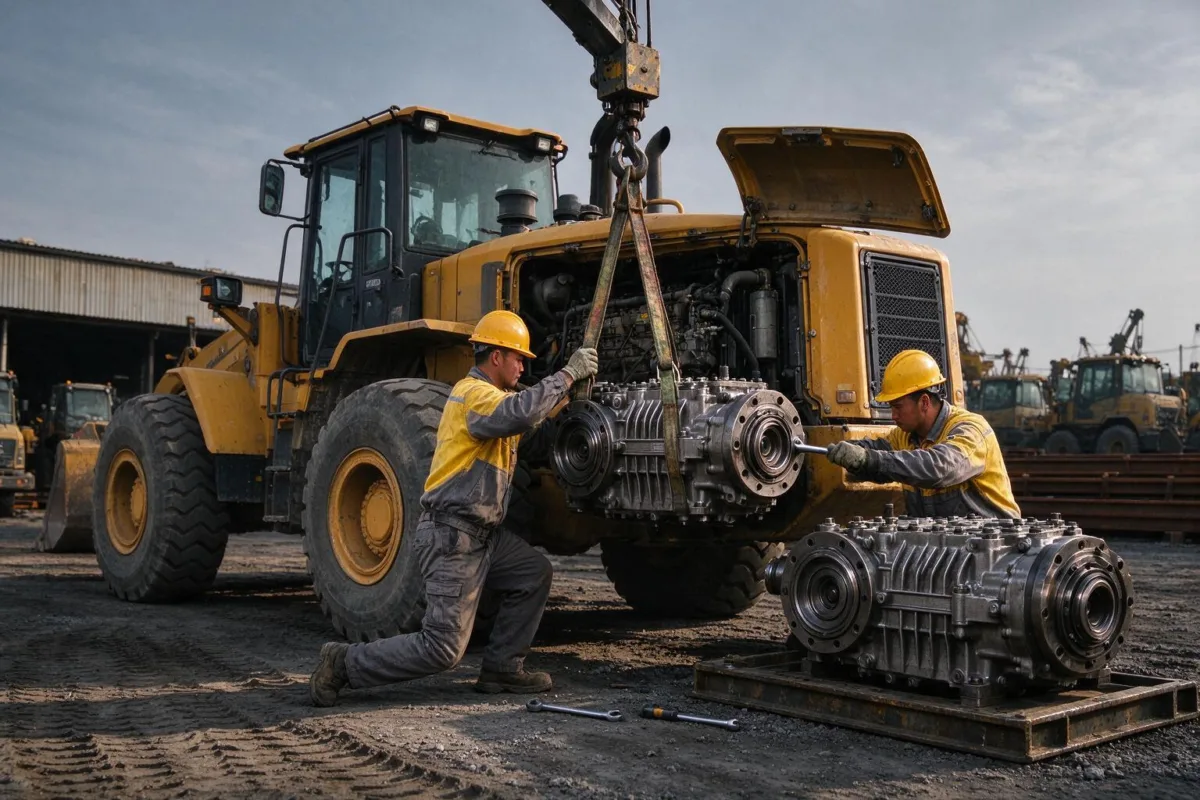
Liugong CLG-series wheel loaders, including the 856, 856H, 862H, and 890H, typically use a ZF-type or Liugong-designed powershift transmission with an integrated torque converter, mated to a Weichai or Cummins diesel engine. Planning the Liugong loader transmission parts replacement cycle therefore starts with the transmission assembly, which comprises the torque converter, planetary gear sets, hydraulically actuated multi-plate clutch packs, a hydraulic control valve body, an oil pump, and the final drive connection. Each subassembly has a distinct service life profile, so replacement planning should be handled at the component level rather than as a single transmission-wide interval.
Baseline Replacement Intervals by Component
Liugong wheel loaders in the 3-ton to 5-ton class (856H, 856M, 862H, and related models) commonly use a ZF-type powershift transmission. Published service schedules and field data give the following baseline intervals. These are starting points; actual replacement should be adjusted for duty cycle, ambient conditions, and oil analysis results.
Fluids and Filtration
Transmission oil typically runs 500 to 1,000 hours between changes. Filter elements are changed more frequently, at 250 to 500 hours, depending on contamination levels and the condition of the breather. Machines working in dusty or high-humidity environments should sit at the lower end of both ranges.
Friction and Hydraulic Components
Clutch pack friction discs and steel plates commonly last 4,000 to 8,000 hours. The lower end applies to high-cycle loading operations such as repeated stockpile work with frequent directional shifts. The transmission hydraulic pump generally reaches 6,000 to 10,000 hours under normal conditions. The control valve body and solenoid components typically run 5,000 to 8,000 hours, though solenoid failure often precedes mechanical wear in the valve body.
Torque Converter, Bearings, and Seals
The torque converter is generally rated for 8,000 to 12,000 hours, but seal and bearing failures can occur earlier and are not tied to the converter’s overall service life. Bearings and seals are inspected at every major service and replaced on condition rather than at a fixed interval.
| Component | Baseline Interval (hours) |
|---|---|
| Transmission oil | 500–1,000 |
| Oil filter | 250–500 |
| Clutch discs and steel plates | 4,000–8,000 |
| Transmission hydraulic pump | 6,000–10,000 |
| Control valve body and solenoids | 5,000–8,000 |
| Torque converter | 8,000–12,000 |
| Bearings and seals | On condition |
Factors That Shorten the Replacement Cycle
The nominal replacement interval for Liugong loader transmission components assumes moderate duty and controlled operating conditions. Several field factors compress that interval and should be accounted for when scheduling clutch pack, valve body, and torque converter service.
High ambient temperatures accelerate oil oxidation and reduce clutch pack life. Machines in tropical or desert operations often need intervals reduced by 20 to 30 percent. Oxidation raises oil viscosity, degrades friction modifier performance, and increases the risk of glazing on the friction discs.
Frequent forward-reverse direction changes, common in stockpile and truck-loading work, increase clutch engagement cycles and heat generation. Each directional shift engages and disengages clutch packs under load, so machines cycling several times per minute accumulate engagement counts far faster than units in continuous travel work.
Contaminated oil from failed seals or poor filtration is the leading cause of premature valve body and clutch failure. Abrasive particles score spool bores, block orifices, and embed in friction material, producing erratic shift pressure and accelerated wear.
Overloading beyond rated bucket capacity raises torque converter slip and oil temperature. Sustained slip converts input energy to heat in the converter and cooler circuit, stressing seals and friction surfaces.
Extended idling and poor cooling system maintenance contribute to elevated transmission oil temperatures. Restricted coolers, degraded coolant, and a failed fan drive all reduce heat rejection, so the transmission runs hotter than the design basis even at moderate loads.
| Factor | Primary effect | Typical interval impact |
|---|---|---|
| High ambient temperature | Oil oxidation, clutch pack wear | Reduce 20–30 percent |
| Frequent direction changes | Engagement cycles, heat | Shortened proportionally to shift frequency |
| Oil contamination | Valve body and clutch failure | Leading cause of premature failure |
| Overloading | Converter slip, oil temperature | Shortened under sustained overload |
| Idling and poor cooling | Elevated oil temperature | Shortened with degraded heat rejection |
Wear Indicators and Condition Monitoring
Condition monitoring of the Liugong loader transmission provides the earliest reliable data for scheduling parts replacement. Oil analysis is the most dependable indicator. Laboratories should track iron, copper, and silicon concentrations alongside viscosity and oxidation values. Rising copper typically signals clutch plate wear, as friction disc facings and bushings release copper into the fluid. Rising silicon points to external contamination, usually through a breather or seal ingress. Viscosity deviation and oxidation indicate fluid breakdown and elevated thermal stress on the clutch packs and valve body.
The magnetic drain plug should be inspected at every oil change. A fine, dark paste on the magnet is normal break-in and service debris. Metallic flakes, bright particles, or clutch friction material indicate internal wear and warrant further inspection before the next interval.
Transmission oil temperature should be monitored continuously through the dash gauge. Sustained operation above 100 degrees Celsius accelerates seal hardening, clutch plate glazing, and fluid oxidation, shortening component life.
Operational symptoms also serve as indicators:
- Delayed or harsh shifting
- Slipping under load
- Loss of torque converter stall speed
These symptoms typically point to clutch pack or valve body wear and should trigger a pressure test at the main and clutch circuits. Pressure testing identifies internal leakage before a hard failure occurs, allowing planned replacement of the affected clutch pack, seal, or valve body rather than a full transmission overhaul.
| Indicator | Normal | Action Threshold |
|---|---|---|
| Copper (oil analysis) | Stable baseline | Rising trend |
| Silicon (oil analysis) | Low, stable | Rising trend |
| Drain plug debris | Fine paste | Flakes or friction material |
| Oil temperature | Below 100 C | Sustained above 100 C |
| Shift quality | Consistent | Delayed or harsh |
Torque Converter and Clutch Pack Service Notes
The torque converter on Liugong wheel loaders (856H, 856, 877H and related series) is generally treated as a sealed unit in field service. Internal failures such as stator one-way clutch slip, bearing noise, or contamination from a failed transmission pump are usually addressed by replacement rather than in-frame rebuild, since converter welding, balancing, and end-play setup require dedicated tooling. Specialist rebuilders do offer exchange units for fleets that prefer to retain the original housing, but the exchange unit should be flow-tested and supplied with a warranty before installation. Contamination in the converter circuit after a clutch failure is a common cause of repeat damage, so cooler and line flushing is part of the same job.
Clutch pack replacement requires transmission removal and full disassembly. At teardown, piston seals, return springs, and the clutch housing should be inspected and are typically replaced regardless of visual condition, because seal hardening and spring fatigue are not reliably judged by eye. Friction disc thickness and steel plate flatness are measured against the service manual specification for the specific model and clutch position. Grooving, blueing, or hot spots on steel plates indicate overheating and warrant replacement of the full set rather than selective reuse.
Clutch clearance must be set to specification during reassembly using the specified selective plates or shims. Incorrect clearance causes drag or delayed engagement, generates heat, and shortens the life of the new pack. Clearance is checked with a feeler gauge or dial indicator per the manual procedure before the unit is closed up.
Hydraulic Control and Filtration Components
The transmission filter is a service item, not a lifetime part. It should be changed at every transmission oil service interval, and the filter housing inspected for debris that would indicate clutch or gear wear upstream. The filter bypass valve also warrants verification at each service. A bypass valve that sticks open allows unfiltered oil to circulate directly to the control valve body and lubricating circuits, accelerating wear throughout the hydraulic system. A valve that sticks closed risks oil starvation at low temperature or high flow demand. Both conditions are checked by verifying the valve opens and seats within its specified pressure differential.
Solenoid valves in the control valve body are electromechanical components and can fail independently of mechanical wear in the clutch packs or gearing. Before removing the valve body, diagnostic codes should be read from the transmission controller using the appropriate service tool, and the solenoid resistance and actuation values checked against specification. Removing the valve body without first capturing stored codes can erase the fault history needed to isolate the failed solenoid from a wiring or controller fault.
Valve body spools and bores wear when contaminated oil passes through the circuit. Scoring, sticking, or visible bore wear require valve body replacement or reconditioning; individual spool replacement alone is rarely sufficient once the bore is damaged. The transmission oil cooler and cooler lines should be flushed during any major transmission service, including after a rebuild, to prevent residual debris from re-entering the rebuilt assembly and repeating the failure.
| Component | Service action | Interval basis |
|---|---|---|
| Transmission filter | Replace | Every oil service |
| Bypass valve | Verify opening and seating | Every oil service |
| Solenoids | Read codes, check resistance | Before valve body removal |
| Valve body | Inspect spools and bores; replace or recondition if scored | Major service or fault diagnosis |
| Oil cooler and lines | Flush | Major service and post-rebuild |
Genuine Versus Aftermarket Parts Identification
Liugong genuine transmission parts carry part numbers that can be cross-referenced against the parts catalog for the specific loader model and serial number range. Because part numbers and component configurations change across production runs, identification should be confirmed against the catalog covering the machine’s serial number, not only its model designation. Packaging, label format, and cast or stamped markings should be verified against documented references before installation.
Aftermarket clutch plates and seals vary in friction material formulation and elastomer quality. Lower-cost kits may meet dimensional specifications but not the heat resistance and cycle life of original components. In transmissions subject to repeated forward-reverse shifting under load, such as those in the 856H and 856H MAX wheel loaders, friction plate formulation directly affects shift quality and service interval. Seal compounds similarly differ in resistance to transmission fluid and operating temperature, and a dimensionally correct seal of lower-grade elastomer may harden or leak well before the expected replacement interval.
Torque converters from non-original sources should be checked for stall ratio and mounting dimensions against the model specification. A converter with a mismatched stall ratio alters engine-transmission matching and can increase heat generation in the transmission circuit.
For critical transmission components, supplier and batch traceability is relevant to warranty and service life expectations. Documented traceability supports warranty claims and allows comparison of failure patterns across batches.
| Check | Genuine Part | Aftermarket Part |
|---|---|---|
| Part number | Cross-reference to catalog by model and serial range | Verify independently; numbering may not correspond |
| Clutch plate friction material | Documented formulation and heat rating | Variable; dimensional match does not confirm cycle life |
| Seal elastomer | Specified compound | Variable quality; check fluid and temperature rating |
| Torque converter | Stall ratio and mounting per model specification | Confirm stall ratio and mounting dimensions |
| Traceability | Supplier and batch documented | Request batch records before purchase |
Service Planning and Record Keeping
A component-level service log is the basis for adjusting transmission replacement intervals to a specific machine. For Liugong loaders, the log should capture the hour meter reading at each replacement, oil analysis results, and the operating conditions under which the machine works. Relevant conditions include load-and-carry versus stockpile work, ambient temperature, dust exposure, and the frequency of torque converter stall events. Machines in the 856H and 856H MAX class that run continuous heavy loading typically reach clutch pack wear limits sooner than units in light utility duty, and the log is what makes that difference visible.
Transmission inspection should be scheduled during planned downtime rather than triggered by failure. An unplanned transmission failure can idle a loader for extended periods while parts are sourced and the unit is pulled from service, and the labor access required for internal transmission work is substantial. Inspections slotted into planned maintenance windows allow clutch pack clearance checks, bearing condition assessment, and seal inspection without disrupting production schedules.
Oil analysis should be read as a trend, not a single sample. Rising iron or copper concentrations across successive samples, or a shift in viscosity, indicate wear progression that justifies early intervention before a clutch pack fails outright. A single out-of-range result is less informative than the direction of the trend over several service intervals.
When one clutch pack is replaced, adjacent packs and bearings should be inspected in the same teardown. Labor access dominates the cost of transmission work, so addressing marginal components while the unit is already open avoids a second removal for a failure that was predictable at the first inspection.