Construction machinery, XCMG Parts
Liugong Loader Parts Buying Guide: Model Series, Component Identification, and Sourcing
Nov
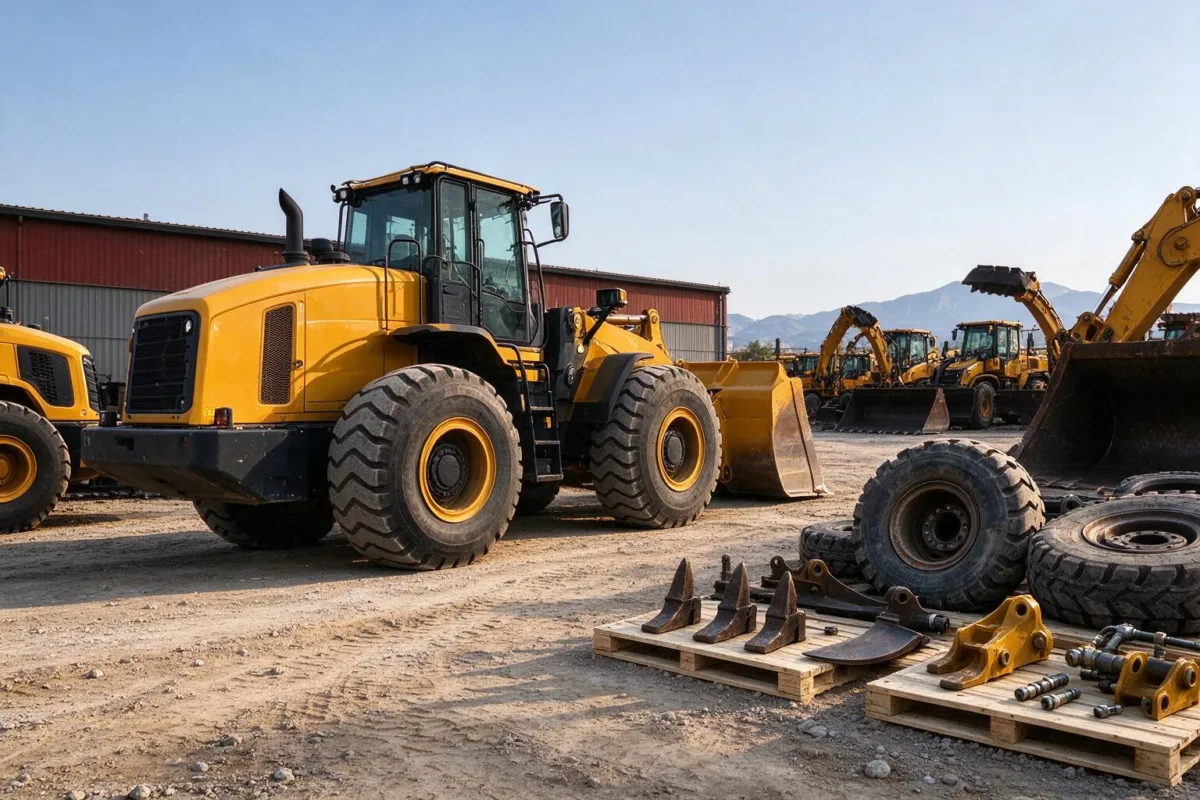
This Liugong loader parts buying guide starts with the model series, because the platform a machine belongs to determines which components are likely to interchange. Liugong wheel loaders are organized into the 800 series, which covers medium and heavy machines, and the smaller 300/400 series. The 856H, 856, 836, 835, 820, and 816 form the most common configurations in export and rental fleets.
Major Component Groups on Liugong Loaders
Liugong loaders are assembled from component groups supplied by multiple vendors, and parts selection must follow the component identification rather than the loader model alone.
Engine and Cooling
Filters (air, fuel, oil), water pumps, turbochargers, radiator cores, and fan drives vary by engine supplier. The engine plate, not the loader model, determines the correct part. Perkins, Cummins, and Yuchai fitments within the same loader series use different filter part numbers and cooling packages.
Transmission and Torque Converter
Clutch packs, solenoids, control valves, and oil pumps are high-wear items. ZF-derived and Liugong-built transmissions use different friction plates and seal kits and are not interchangeable.
Axles and Driveline
Differential assemblies, planetaries, brake discs, and drive shafts are load-critical. Confirm axle ratio and brake type (wet disc versus dry) before purchase.
Hydraulics
Main pumps, priority valves, steering cylinders, lift and tilt cylinders, and hose assemblies. Seal kits are model-specific and should be ordered by part number.
Work Equipment
Buckets, teeth, adapters, cutting edges, and wear plates are the highest-turnover category, commonly sourced from aftermarket specialists.
Cab and Electrical
Wiring harnesses, sensors, monitors, and control levers differ significantly between the 856 and 856H and are frequent sources of mismatch.
| Group | Key wear items | Identification basis |
|---|---|---|
| Engine and cooling | Filters, water pump, turbocharger | Engine plate |
| Transmission | Clutch packs, solenoids, seals | Transmission build (ZF-derived vs. Liugong) |
| Axles | Brake discs, planetaries | Axle ratio, brake type |
| Hydraulics | Pumps, cylinders, seals | Part number |
| Work equipment | Teeth, edges, wear plates | Bucket size and pin dimensions |
| Cab and electrical | Harnesses, sensors, levers | Model variant (856 vs. 856H) |
How to Identify the Correct Part for a Liugong Loader
Accurate part identification begins with the machine serial number plate, typically mounted on the frame near the articulation joint or inside the cab. The full serial number, including the production year code, should be recorded exactly as stamped. Liugong parts catalogs are organized by machine serial range rather than by marketing model name, so a catalog for a 856H will not necessarily cover every 856H built across different production periods.
Driveline components require separate identification. The engine model and serial number appear on the engine plate, while the transmission and axle assemblies carry their own model plates where fitted. For engines, transmissions, axles, and related components, these sub-assembly numbers override the loader model when ordering parts.
Before ordering, cross-check the part number stamped or cast on the failed component against the catalog entry. Casting numbers and service part numbers are not always identical, and a casting reference may correspond to a superseded or assembly-level part number.
Photographing the component in place before removal is recommended, with a scale reference and any visible markings included in the frame. This practice reduces ordering errors on seals, hoses, and sensors, where small dimensional differences are difficult to confirm after disassembly.
Where a catalog is unavailable, measure critical dimensions and match them against supplier specification sheets:
| Component | Dimensions to Record |
|---|---|
| Hydraulic cylinder seals | Bore, rod diameter, stroke |
| Hoses | Length, internal diameter, end fitting type |
| Drive shafts | Spline count, flange pattern, length |
| Sensors | Thread size, connector type, voltage |
Matching measured values against published specifications confirms fitment before purchase.
OEM, OES, and Aftermarket Parts: What the Differences Mean
OEM parts are produced to Liugong’s drawings and specifications, whether by Liugong itself or by a contracted supplier working to the same controlled documentation. This gives the highest dimensional and material consistency, and correspondingly the highest price. For a wheel loader in continuous production use, that consistency is the main argument for OEM in critical assemblies.
OES (original equipment supplier) parts come from the same supplier that builds the component for Liugong, but are sold under the supplier’s own brand. Material specification is often equivalent, and cost is typically lower than OEM. Buyers should confirm that the OES part number maps to the same drawing revision as the machine’s serial range, since suppliers sometimes carry several variants.
Aftermarket parts vary widely. Reputable manufacturers publish material grades, hardness figures, and dimensional tolerances. Low-cost suppliers generally do not, which makes verification impossible before installation.
For wear parts such as bucket teeth and cutting edges, hardness and fit tolerance are the key differentiators. Teeth commonly fall in the 45 to 55 HRC range, with edge segments often specified higher; a tooth that is too soft wears quickly, while one that is too hard can crack under impact loading.
For driveline and hydraulic components, the risk of premature failure from substandard metallurgy or seal quality is higher, so OEM or verified OES is generally preferred.
| Category | Typical choice | Reason |
|---|---|---|
| Engine, transmission, hydraulic internals | OEM or verified OES | Failure cost and contamination risk |
| Bucket teeth, cutting edges, wear plates | Qualified aftermarket | High turnover, published hardness and tolerance |
A practical policy is to reserve OEM or OES for engine, transmission, and hydraulic internals, and to use qualified aftermarket parts for ground-engaging and high-turnover wear items.
Inspection Checklist When Receiving Loader Parts
Receiving inspection is the first control point in any Liugong loader parts procurement process. The checks below should be completed before the part is released to the workshop or stock.
Documentation and Packaging
Verify the part number, quantity, and packaging labels against the purchase order before unpacking. Label discrepancies on Liugong 856H, 856, and 836 series components are common when aftermarket suppliers consolidate shipments. Photograph the carton labels and packing list at this stage.
Structural and Hydraulic Castings
Check for casting defects, porosity, and machining marks on structural and hydraulic components. Inspect lift arm pivots, bell cranks, and hydraulic valve bodies for sand inclusion, cold shuts, and unfinished machined surfaces. Porosity near threaded ports is a rejection criterion.
Seals, Bearings, and Bushings
Confirm dimensional tolerances on seals, bearings, and bushings with calipers against the specification. Measure bore and outer diameters on pin bushings and check seal cross-sections against the catalogue data. Undersized bushings will produce premature pin wear.
Hydraulic Hoses
Inspect hydraulic hoses for correct pressure rating, crimp quality, and date of manufacture. Rubber older than five years should be rejected regardless of storage condition. Check that the crimp ferrule is square to the fitting and that the lay line is not twisted.
Filters
Check filter media and bypass valve configuration against the engine or transmission requirement. A bypass valve set to the wrong cracking pressure will either starve the circuit or fail to protect it.
Electrical Parts
For electrical parts, confirm connector type, pin count, and voltage rating. Photograph the connector before installation to support any later claim.
Records
Record receipt inspection results and retain packaging for warranty claims. Retain records for the warranty period specified in the supply agreement.
| Check | Component | Rejection Criterion |
|---|---|---|
| Part number and quantity | All parts | Mismatch with purchase order |
| Casting integrity | Structural, hydraulic | Porosity at threaded ports |
| Dimensions | Seals, bearings, bushings | Outside specification tolerance |
| Hose date code | Hydraulic hoses | Older than five years |
| Bypass valve setting | Filters | Incorrect cracking pressure |
| Connector configuration | Electrical | Wrong pin count or voltage |
Supplier Verification for Liugong Parts
Verification should begin with documentation. A credible supplier can provide a current business license, export records showing shipments of construction equipment parts, and references from prior buyers operating in the same segment, such as wheel loaders in the 856H or 856M class. References from unrelated industries carry limited weight.
Buyers should ask for the manufacturer name behind each aftermarket part, not only the trading company name. Trading companies frequently relabel components from multiple sources, so the same part number may arrive from different foundries across orders. Identifying the actual producer allows consistent quality comparison between shipments.
For wear parts and metallurgical components, request material certificates or hardness test reports. Ground-engaging tools, bucket teeth, cutting edges, and pin-and-bushing sets should be traceable to a specified steel grade and hardness range. Reports without a heat or batch number are difficult to verify.
Warranty terms require written confirmation of the coverage period, the claim process, and whether labour is included. Labour coverage varies widely and affects the real cost of a failure on a machine in production.
Confirm whether the supplier holds stock for the specific serial range or sources on demand. Stocked items shorten lead time and improve consistency; on-demand sourcing introduces variability between orders.
Before a large commitment, place a small trial order and inspect the received parts against the same checklist.
| Verification Item | What to Request | Purpose |
|---|---|---|
| Business standing | License, export records | Confirm legitimate trading history |
| Part origin | Manufacturer name per part | Avoid unidentified relabeled sources |
| Material quality | Certificates, hardness reports | Verify steel grade and wear resistance |
| Warranty | Written terms, claim process | Establish coverage and labour inclusion |
| Availability | Stock status by serial range | Assess lead time and consistency |
Maintenance Intervals and Consumable Planning
Consumable planning for Liugong loaders should be built around the service intervals in the machine’s operation and maintenance manual, with adjustments for fuel quality, duty cycle, and contamination control.
Engine Service
Engine oil and filter intervals follow the engine supplier’s schedule rather than a single Liugong figure. For the Cummins and Yuchai engines fitted to many 856H, 856, and 835H models, that interval is typically 250 to 500 hours. Machines running high-sulfur fuel, extended idling, or heavy load-and-carry cycles should sit at the shorter end of that range. Oil sampling at each change helps confirm whether the interval can be extended.
Transmission and Hydraulics
Transmission oil and filter changes are commonly scheduled at 1,000 hours. On high-hour machines, oil analysis is recommended before and after the change to catch clutch pack wear and coolant ingress early. Hydraulic oil and return filter changes depend on contamination control targets rather than a fixed calendar; breather and pilot filter replacement are frequently overlooked and should be included in every hydraulic service.
Ground-Engaging Tools
Bucket teeth and cutting edges should be inspected daily in abrasive applications such as quarry and aggregate work. Wear beyond 70 percent of the original section warrants replacement to protect the bucket lip and base edge.
Consumption Forecasting
Track consumption by machine serial number to build a parts forecast and reduce downtime from stockouts. A simple planning table helps:
| Component | Typical Interval | Planning Basis |
|---|---|---|
| Engine oil and filter | 250–500 h | Engine supplier schedule |
| Transmission oil and filter | 1,000 h | Oil analysis at high hours |
| Hydraulic return filter | Contamination-based | Sampling results |
| Bucket teeth | Daily inspection | 70 percent section wear |
Common Sourcing Mistakes and How to Avoid Them
Several recurring errors drive up cost and downtime when sourcing Liugong loader parts. Most are avoidable with accurate machine identification and disciplined supplier vetting.
Ordering by model name only. A request for “856 parts” without the serial number range is the most frequent cause of mismatched components. Liugong applied running changes to engine and transmission configurations across the 856 build history, so a part correct for one serial block may not fit another. Always supply the full serial number and engine arrangement number with any inquiry, particularly for internal engine and transmission components.
Assuming 856H commonality with the 856. Bucket and cutting edge compatibility between the two is common and generally reliable. Hydraulic and electrical parts are not interchangeable in the same way; valve bodies, sensors, harnesses, and pump assemblies frequently differ in mounting, connector type, and control logic. Treat these categories as model-specific and confirm by part number.
Buying on lowest price for hydraulic pumps and injectors. Low-cost aftermarket pumps and injectors often fail early, and their failure modes are not contained: contaminated hydraulic fluid circulates through cylinders and valves, and injector failure can score bores or dilute oil. Specify traceable remanufactured or OEM-equivalent units with a documented test report.
Ignoring hose pressure and temperature ratings. Hoses selected on dimension alone burst in high-duty cycles. Match working pressure to system relief pressure with margin, and confirm the temperature rating against hydraulic oil operating temperature.
Failing to verify supplier traceability. Suppliers who cannot provide part numbers, batch or lot data, and warranty terms create problems at claim time and make repeat orders unreliable. Request documentation before the first order.
| Mistake | Verification step |
|---|---|
| Model-only ordering | Serial number and engine arrangement number |
| 856H/856 parts assumed common | Part number confirmation for hydraulic and electrical items |
| Lowest-price pumps and injectors | Test report and warranty terms |
| Underspecified hoses | Pressure and temperature rating check |
| Untraceable supplier | Lot data and written warranty |
