Construction machinery, XCMG Parts
XCMG Excavator Hydraulic Pump Selection Guide
Nov
This XCMG excavator hydraulic pump selection guide addresses main pumps, pilot pumps, and swing/boom priority configurations on the common series (XE215, XE270, XE370, XE490, and related variants). The purpose of this XCMG excavator hydraulic pump selection guide is to give maintenance engineers, fleet owners, and parts buyers a structured method for matching a replacement pump to a specific machine without depending on manufacturer-only channels.
The content is written for readers who already have a machine in front of them and need to identify the correct pump assembly, confirm its control method, and verify that a candidate replacement will bolt up and function correctly. It is not a general primer on hydraulic systems and does not cover machine-level troubleshooting beyond what is needed to confirm pump type.
Selection criteria are presented in the order they should be applied. Applying them out of sequence, for example choosing a pump by displacement before confirming the machine variant, is a common source of mismatched parts.
| Step | Criterion | What to Confirm |
|---|---|---|
| 1 | Machine identification | Series, model suffix, serial range |
XCMG Excavator Series and Pump Configurations
The XE series spans the mainstream hydraulic excavator range. Compact units begin at the XE15 class, with small and medium models running through the XE35 to XE215 band, and large units occupying the XE370 to XE700 class. Pump configuration changes considerably across these size classes, so the model designation is the first filter in any selection process.
Small and medium models, roughly XE35 to XE215, commonly use variable displacement axial piston pumps in single or tandem arrangement. A separate pilot pump or an integrated pilot stage supplies control pressure for the main valve and joystick circuits. On these machines the main pump displacement and regulator type are the primary selection criteria.
Larger models, XE265 and above, typically use tandem main pumps with independent regulators for each circuit, plus a dedicated pilot gear pump. The independent regulators allow the two main circuits to respond separately to load, which matters for multi-function work and for matching pump output to attachment demand.
Wheeled excavators in the XE150W to XE210W range use pump packages similar to their crawler equivalents but with different auxiliary circuit demands. Steering, travel, and brake circuits draw on the hydraulic system in ways that crawler machines do not, so the auxiliary pump and priority valve arrangement must be checked against the specific wheeled model.
Older and grey-market machines may carry pumps from more than one supplier, so series alone is not sufficient for identification. Confirm the pump part number, displacement, and regulator type from the machine plate or the pump nameplate before ordering.
| Model class | Typical pump arrangement |
|---|---|
| XE15 to XE80 | Single or tandem variable axial piston, integrated or separate pilot stage |
| XE35 to XE215 | Variable axial piston, single or tandem, separate or integrated pilot pump |
| XE265 and above | Tandem main pumps with independent regulators, dedicated pilot gear pump |
| XE150W to XE210W | Crawler-equivalent pump package, modified auxiliary circuits |
Identifying the Machine Before Selecting a Pump
Pump selection for XCMG excavators begins with accurate machine identification, since hydraulic specifications vary across series and within a single series by build year. The machine plate provides the starting point: record the full model designation, serial number, and engine model exactly as stamped. A unit listed as an XE215C, for example, may carry different pump requirements depending on its production year and any running changes applied during that period.
The pump itself carries a manufacturer’s plate with data that must be recorded independently of the machine plate. Key fields include rated pressure, maximum displacement, rotation direction, and regulator type. These values define the pump’s hydraulic envelope and control behavior; substituting a unit with a different regulator type can alter flow response under load.
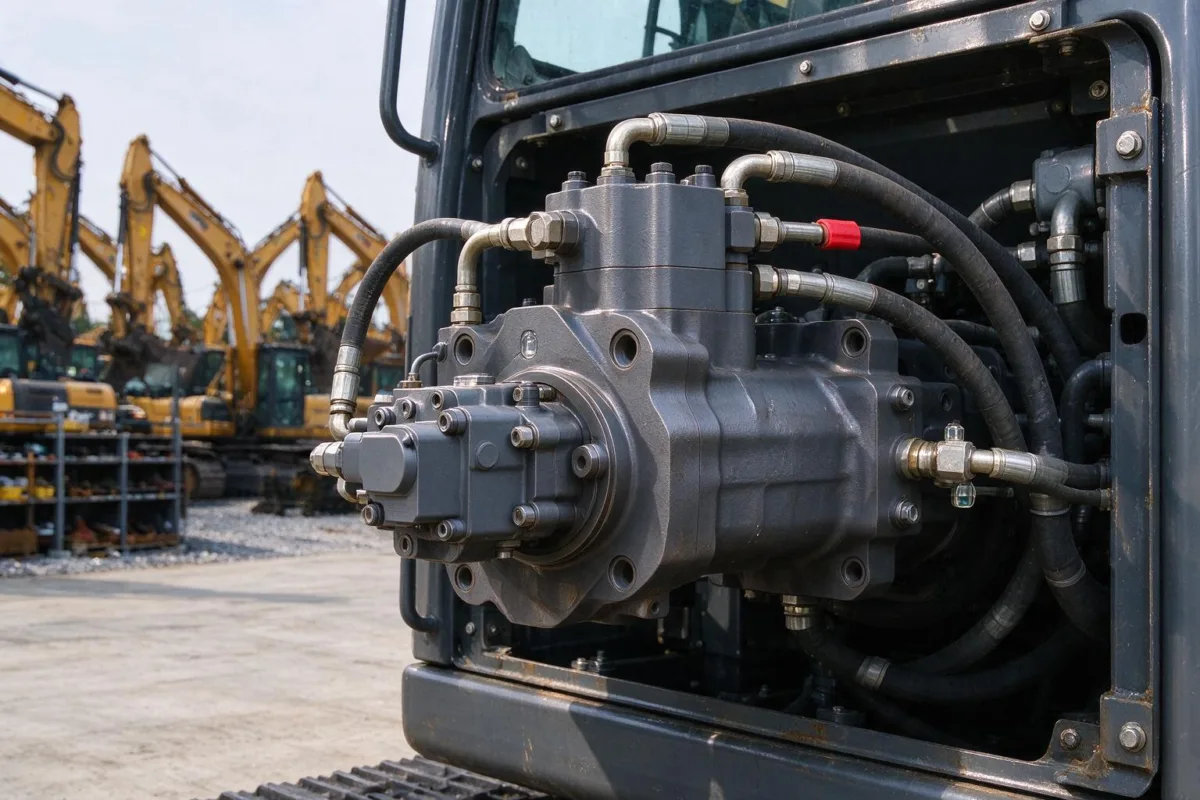
Before ordering, photograph the pump mounting flange, the shaft spline or key, and the positions of the suction, delivery, and drain ports. Interface dimensions are not reliably inferred from model numbers alone, and photographic evidence confirms bolt patterns, pilot diameter, and port orientation against the replacement unit.
The pilot circuit arrangement also requires verification. Machines fitted with proportional solenoid control need a pump with matching regulator hardware, including the correct solenoid valve body and feedback provisions. A pump from a manually controlled variant of the same series will not interchange without modification.
Where the original pump plate is unreadable or missing, the machine serial number should be cross-referenced against the parts book for that build range. Visual similarity between pumps is not a reliable selection method, as external housings may appear identical while internal displacement and regulator configuration differ.
Pump Types and Their Application Fit
XCMG excavator hydraulic systems use several pump architectures, and the correct choice depends on circuit function, control strategy, and machine size.
Variable Displacement Axial Piston Pumps
Variable displacement axial piston pumps are the standard for main circuits across the XCMG range, from compact units to large crawler machines. These pumps offer pressure compensation and flow control across the working range, allowing the main circuit to match output to demand. Swashplate angle adjustment responds to load pressure, reducing flow when actuators stall and limiting energy loss.
Gear Pumps
Gear pumps serve pilot circuits and, on some compact models, auxiliary functions. They are lower cost but fixed displacement, so they suit steady-demand circuits such as pilot pressure supply rather than variable main-circuit work. Their simplicity and tolerance of contamination make them a practical choice for low-flow duties.
Tandem Pump Arrangements
Tandem pump arrangements supply two independent circuits, typically travel plus attachment, and must be matched as a pair for balanced performance. Mismatched halves can cause uneven travel tracking or inconsistent combined operation.
Regulator Compatibility
Load-sensing and negative-flow control regulators are not interchangeable. The regulator type must match the machine’s hydraulic control strategy. A load-sensing regulator on a negative-flow system, or the reverse, will produce incorrect pump response and poor controllability.
Open-Circuit Versus Closed-Circuit
Open-circuit pumps dominate XCMG excavator applications. Closed-circuit pumps appear mainly in specific travel or specialty configurations where a compact, reversible hydrostatic loop is required.
| Pump Type | Typical Circuit | Control Characteristic |
|---|---|---|
| Variable axial piston | Main | Pressure compensation, flow control |
| Gear | Pilot, auxiliary | Fixed displacement |
| Tandem | Travel plus attachment | Paired, independent circuits |
Matching Displacement, Pressure, and Speed
Hydraulic pump selection for XCMG excavators depends on three interdependent parameters: displacement, rated pressure, and maximum speed. A pump that satisfies one specification but not the others will underperform or fail prematurely.
Displacement must match the original pump specification for the machine model. A larger-displacement pump increases flow, but the added load can exceed the engine’s torque limit at the pump drive, producing stall under load or sustained overheating. Flow increases do not translate into usable performance unless the engine and hydraulic circuit are rated for them.
Rated pressure must meet or exceed the machine’s main relief valve setting. A pump rated below system pressure operates at its limit continuously, which accelerates wear on the rotating group and can lead to failure. Confirm the relief setting for the specific model series before specifying a replacement.
Maximum speed rating must be compatible with the engine’s governed speed multiplied by the pump drive ratio. Overspeeding a pump beyond its rating reduces volumetric efficiency and shortens bearing and slipper life.
The replacement pump’s control curve should also match the original, particularly on machines used in high-demand applications such as trenching or rock breaking, where load-sensing or negative-flow control behavior affects cycle times and stability. Where an exact original pump is unavailable, consult the pump manufacturer’s data sheet and select a performance-equivalent unit on displacement, pressure, speed, and control characteristics rather than a physically similar pump with a different rating.
| Parameter | Requirement |
|---|---|
| Displacement | Matches original specification |
| Rated pressure | Meets or exceeds relief valve setting |
| Maximum speed | Compatible with governed engine speed and drive ratio |
| Control curve | Matches original, especially in high-demand work |
Mounting Interface and Installation Checks
Mechanical fit must be confirmed before the pump is bolted to the engine or gearbox. Verify the flange type (SAE A, SAE B, SAE B-B, or SAE C as applicable to the machine) and the bolt pattern against the original unit. Shaft specification requires the same level of scrutiny: spline count and pitch, key width and height, and shaft diameter and length all determine whether the replacement will seat correctly and transmit torque without fretting. A shaft that appears similar but differs by a few thousandths or one spline tooth will not interchange.
Port verification follows the mechanical check. Confirm suction, delivery, drain, and pilot port sizes, thread types, and angular positions. Ports clocked differently from the original force hose rerouting, which can add bends, lengthen runs, and restrict flow at the suction side in particular.
Rotation direction is defined when viewed from the shaft end and is not reversible on most units. A pump built for clockwise rotation will not run correctly counterclockwise. Confirm the drain line routes to tank without back pressure, and that case drain flow and pressure limits match the pump specification. Excess case pressure can displace shaft seals and damage internal components.
After installation, allow for circuit flushing and filter replacement before full-load operation. Verify suction line integrity, including clamp tightness and hose condition, to prevent air ingress and cavitation on first start.
Distinguishing Genuine, OEM-Supplier, and Aftermarket Pumps
Excavator hydraulic pumps for XCMG machines reach the market through three distinct supply routes, and each leaves different physical evidence on the unit.
Genuine pumps carry the XCMG parts label and a traceable part number that can be matched against the machine’s serial number and parts catalog. The label, part number, and packaging should correspond exactly.
OEM-supplier pumps are built by the original component manufacturer that supplies XCMG’s assembly lines. These units may carry the component manufacturer’s plate rather than an XCMG label. The part number and supplier identity should still be verifiable in writing.
Aftermarket pumps vary widely in quality. Inspection should focus on:
- Casting quality — porosity, flash, and inconsistent surface finish suggest low-grade tooling.
- Machining marks — genuine regulator and valve bores show uniform, controlled machining patterns.
- Plate engraving — counterfeit units often show inconsistent font, missing serial numbers, or painted-over plates.
- Regulator components and internal valve markings — these are frequently substituted in low-cost rebuilds and should be checked against known examples.
Rebuilt or remanufactured pumps should be supplied with documentation of replaced components, test pressure results, and a defined warranty period. A unit without this paperwork cannot be assessed against the original specification.
Purchasing through channels that provide the pump’s manufacturer and part number in writing is the practical safeguard. Retaining that documentation supports warranty claims and allows the unit to be traced if a regulator or valve failure occurs later.
Selection Checklist and Common Errors
Hydraulic pump replacement on XCMG excavators requires verification against the machine’s original configuration, not assumption. The following checklist reduces mismatch risk during cross-referencing.
Pre-Selection Verification
Confirm the machine model, serial number, and build year before any cross-reference is attempted. XCMG has revised pump specifications across production runs of the same model, so a serial number break is often the only reliable discriminator. Match pump type, displacement, rated pressure, and regulator type to the original specification. Regulator type is frequently overlooked: a pump with the correct displacement but a different regulator (for example, negative flow control versus positive flow control) will not deliver the intended flow characteristics.
Verify flange, shaft, and port interfaces physically or by photograph. Pilot port threads, drain port position, and shaft spline count vary between otherwise similar units. Confirm rotation direction and drain requirements, since a pump intended for opposite rotation cannot be corrected by hose routing alone.
Common Errors
| Error | Consequence |
|---|---|
| Selecting by machine series alone | Wrong displacement or regulator for the specific build |
| Selecting by visual similarity | Interface mismatch at flange, shaft, or ports |
| Selecting by price without verified specifications | Premature failure or degraded cycle times |
| Fitting higher displacement without confirming engine and cooling capacity | Overload, overheating, or ECU derate |
A higher-displacement pump increases torque demand on the engine and heat load on the cooling system; both must be confirmed before fitment. Finally, document the installed pump’s part number and supplier for future reference, so subsequent service orders reference verified data rather than repeating the cross-reference process.
